
By D. Brian Smith
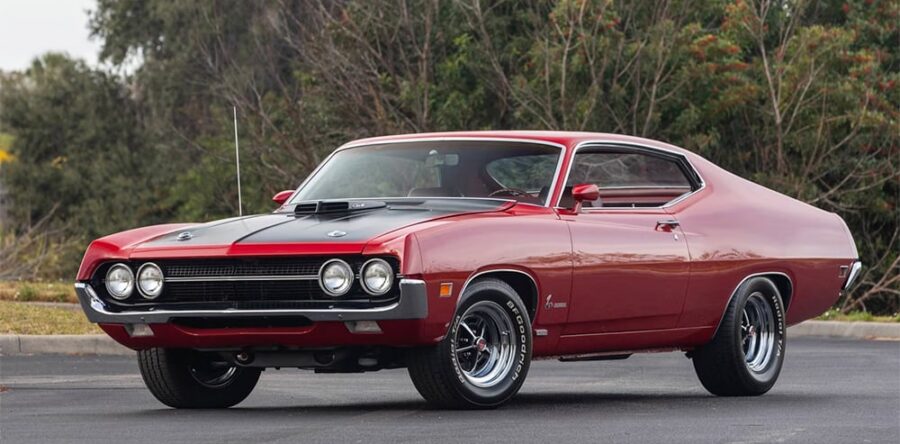
 Few American muscle cars wear their performance credentials quite as convincingly as a Ford Torino Cobra with a snarling big-block V8 beneath its long, muscular hood. From the sleek, NASCAR-inspired SportsRoof models of the late 1960s to the unmistakable Gran Torino Sport of the early 1970s, Ford's intermediate lineup delivered a compelling combination of horsepower, attitude, and Blue Oval engineering.
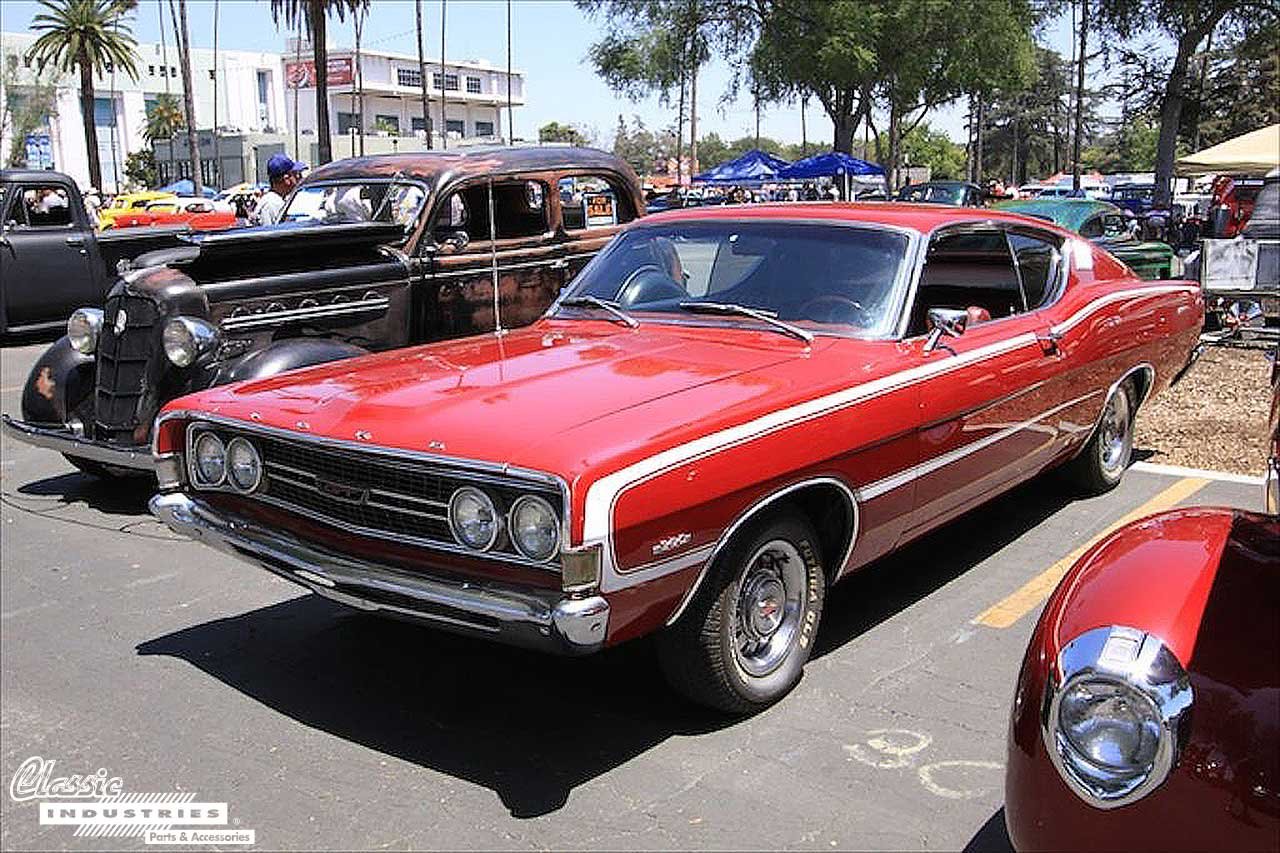
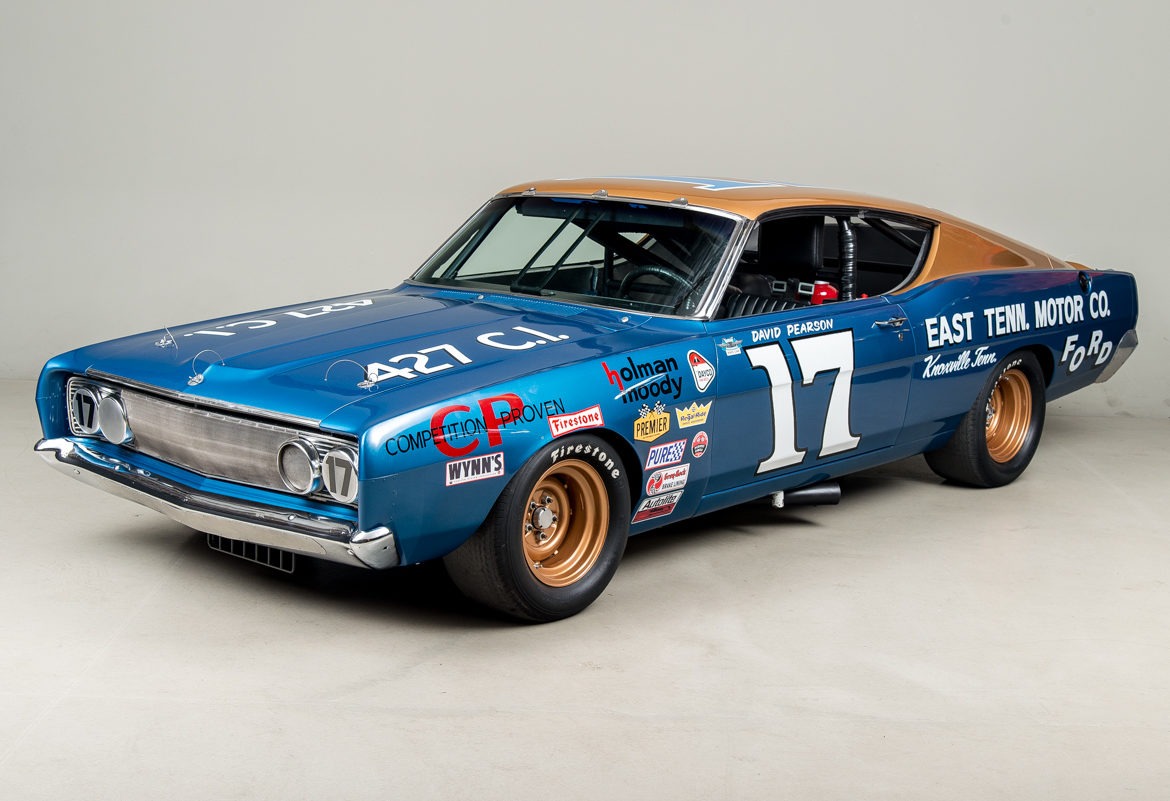
Above: The 1968 Ford Torino GT was photographed at the L.A. Roadsters Show at Pomona Fairplex several years ago (photo courtesy of DBS). The first photo is of a Holman Moody campaigned, 427 big block Ford V8 race mill powered NASCAR 1968 Torino (photo courtesy of Canepa).
Some Torinos were practical family transportation. Others were asphalt-assaulters equipped with 428 Cobra Jet or 429 Cobra Jet engines, heavy-duty drivetrains, and enough tire-shredding torque to make a Sunday afternoon drive particularly entertaining.
But nearly six decades after the Torino first appeared, how can an enthusiast determine precisely what rolled off Ford's assembly line?
Is that beautifully restored 1970 Torino really a factory Cobra? Did the car leave the factory with a 429 Cobra Jet, or did someone install that engine during a restoration? Is the shaker hood original equipment? And what about the transmission, rear axle, paint color, and interior?
That's where the vehicle identification number, better known as the VIN, enters the picture.
For classic Ford owners, restorers, collectors, and prospective buyers, understanding the VIN and factory door data plate can reveal a remarkable amount about a vehicle's original identity.
In this Classic Industries guide, we'll explore how to decode 1968–1976 Ford Torinos, including the closely related Fairlane models, high-performance Cobras, Torino GTs, and later Gran Torinos. We'll also explain what these identification numbers can—and cannot—tell you about a particular automobile.
So, grab your flashlight, open the driver's door, and let's do a little Blue Oval detective work.
From Fairlane to Torino: Nine Years of Ford Intermediate History
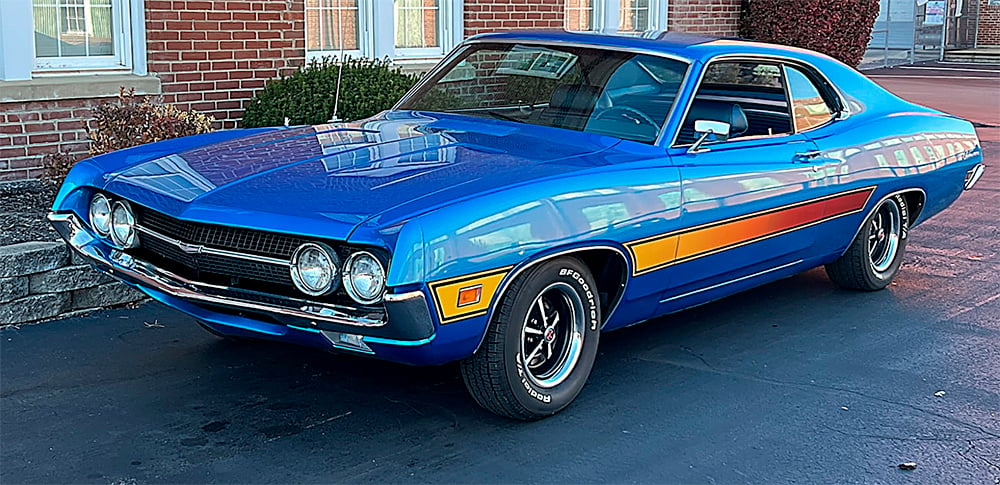
Above: Here's a 1970 Ford Fairlane 500 (photo courtesy of Mecum Auctions).
1968–1969: The Torino Arrives
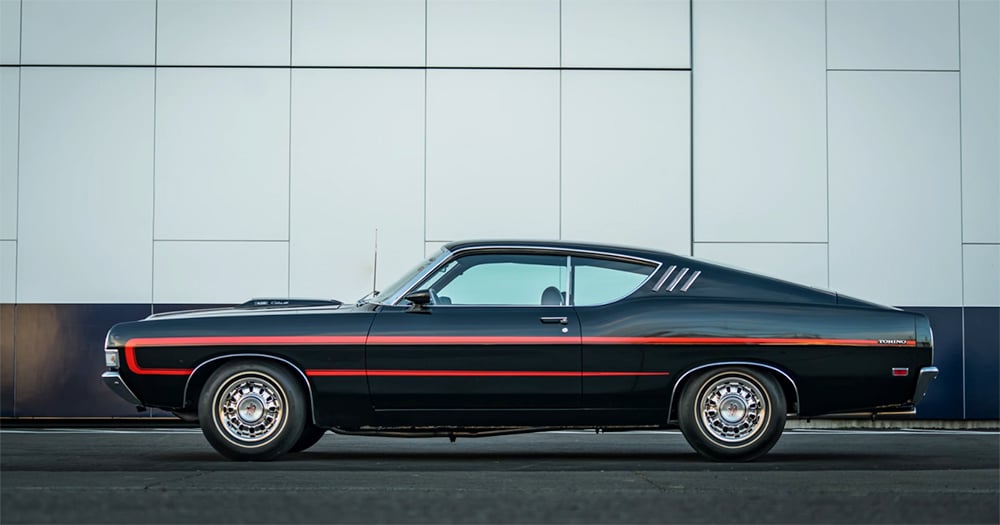
Above and below: 1969 Ford Torino 428SCJ GT, VIN: 9H42R164618 - sold at Mecum Auctions Indy 2019 for $110,000 (photos courtesy of Mecum Auctions)
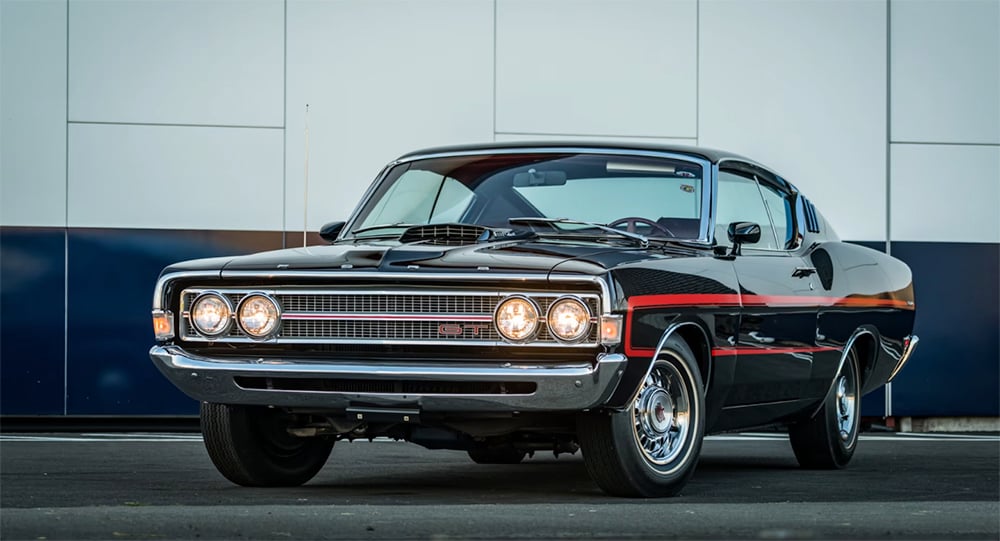
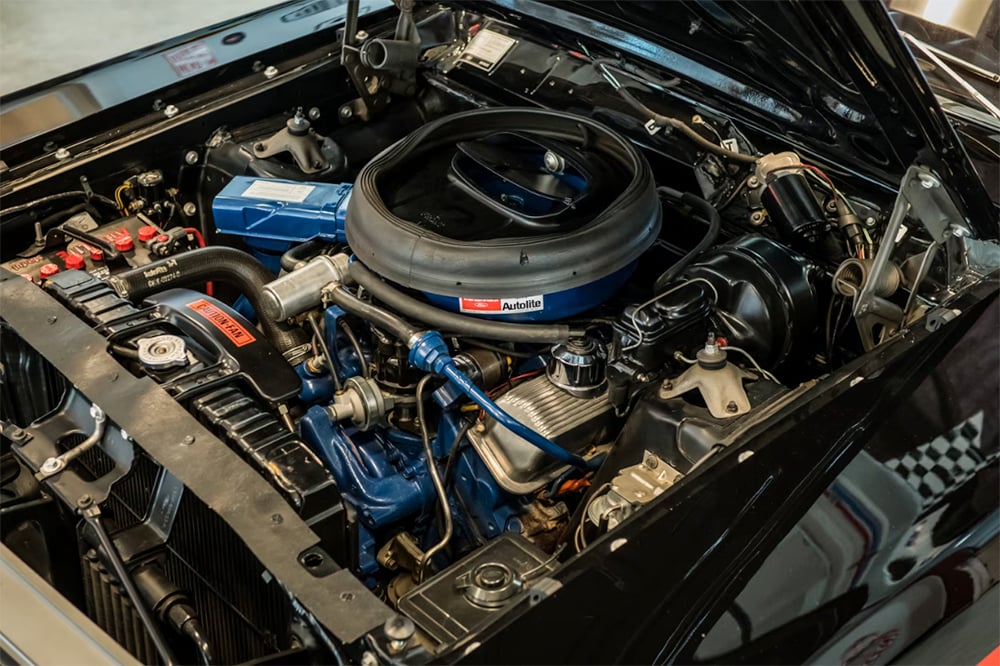
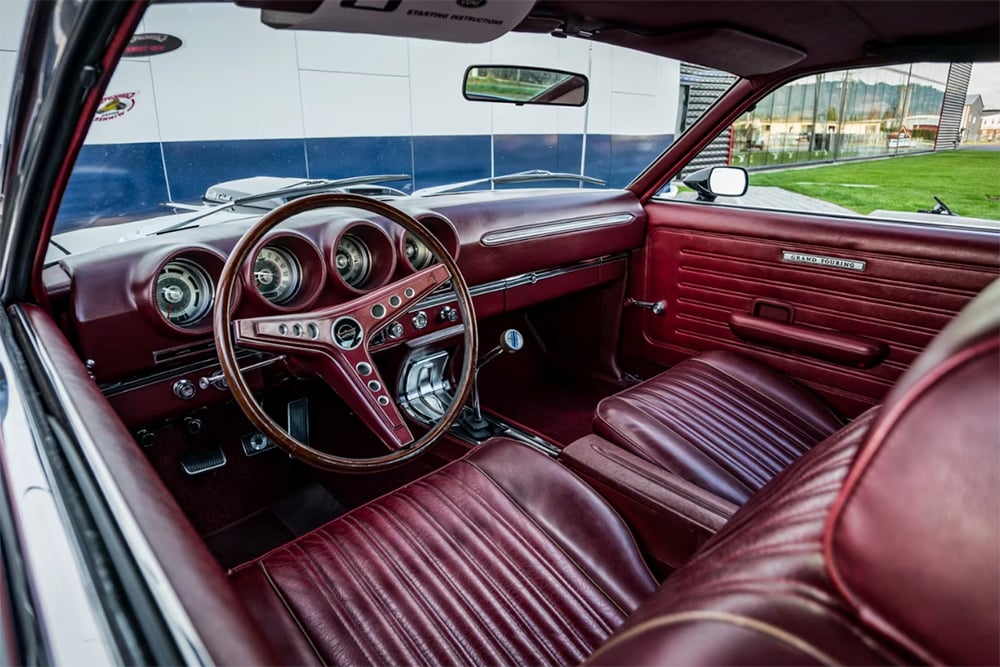
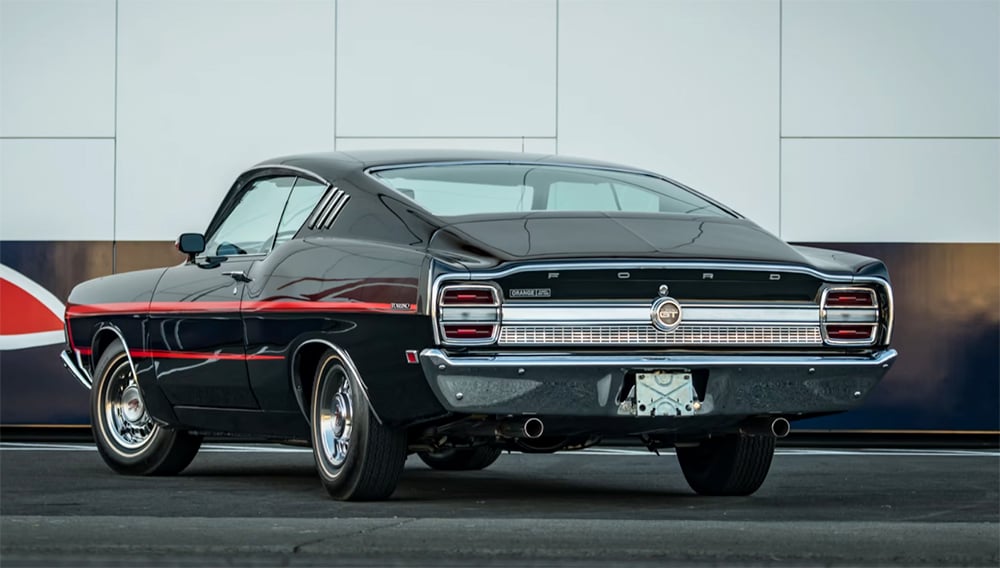
Introduced for 1968 as an upscale member of the Fairlane family, the Torino soon established its own performance identity. The Torino GT, particularly in fastback form, became an appealing alternative to the Mustang for enthusiasts who wanted more room without sacrificing muscle-car character.
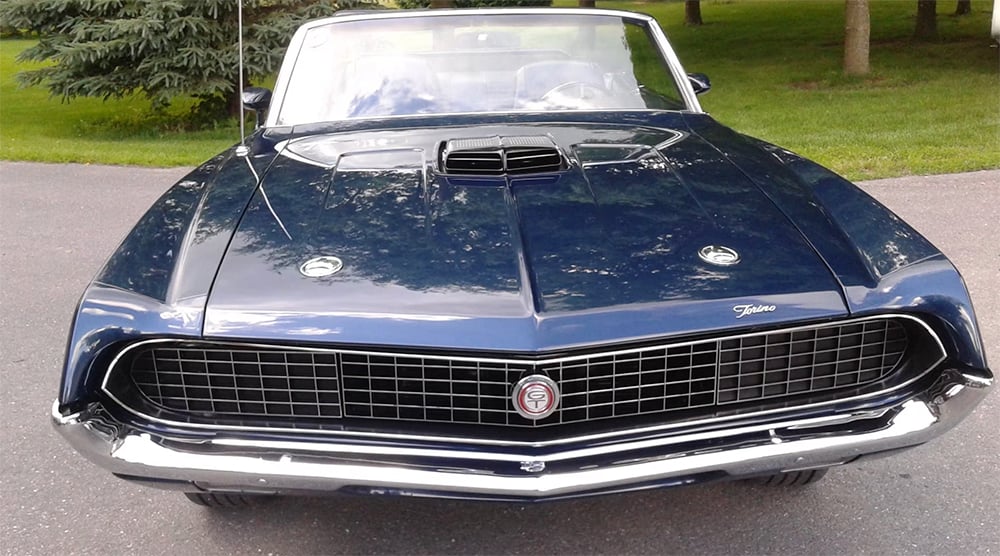
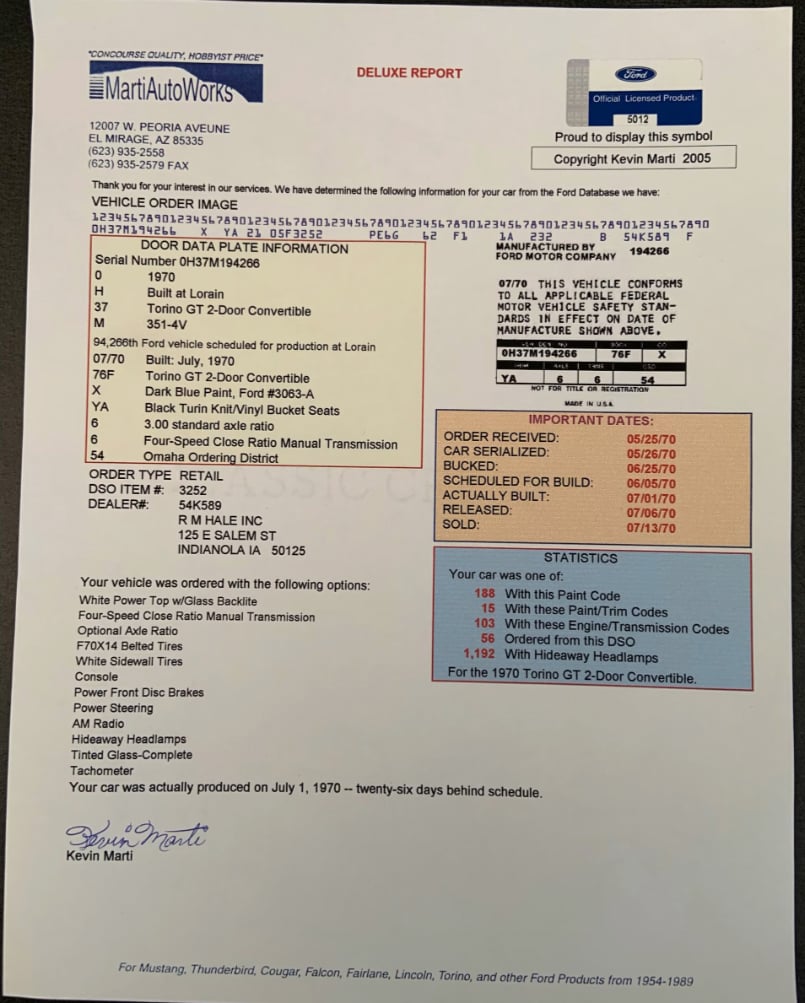
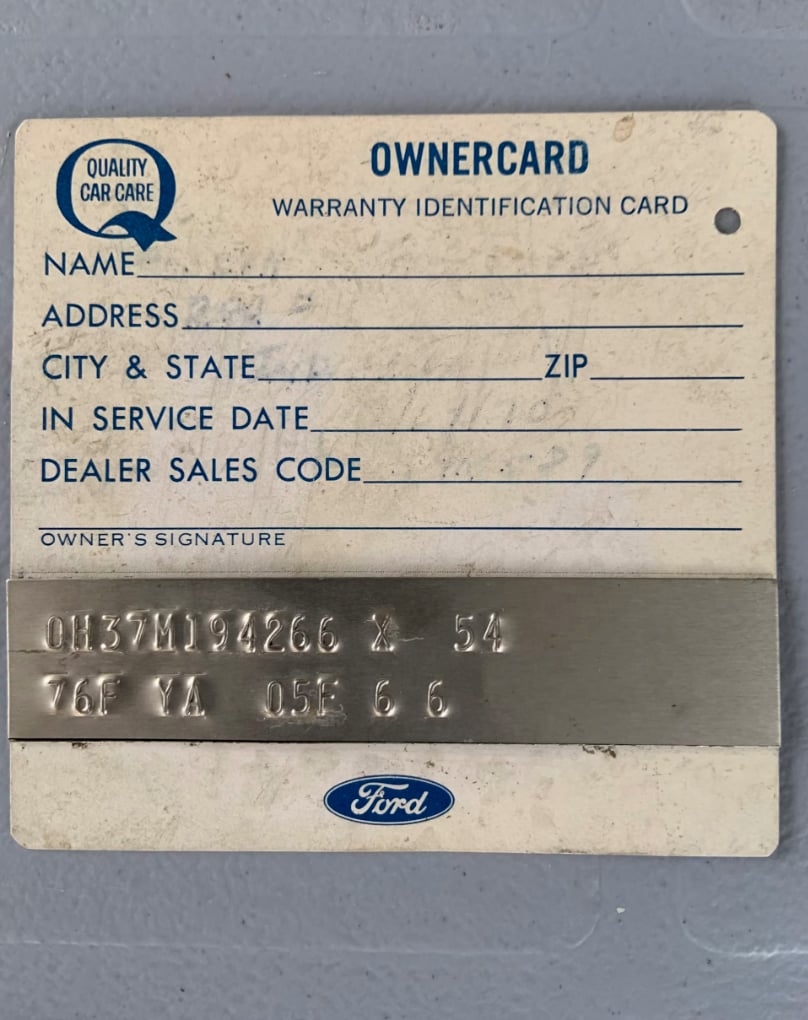
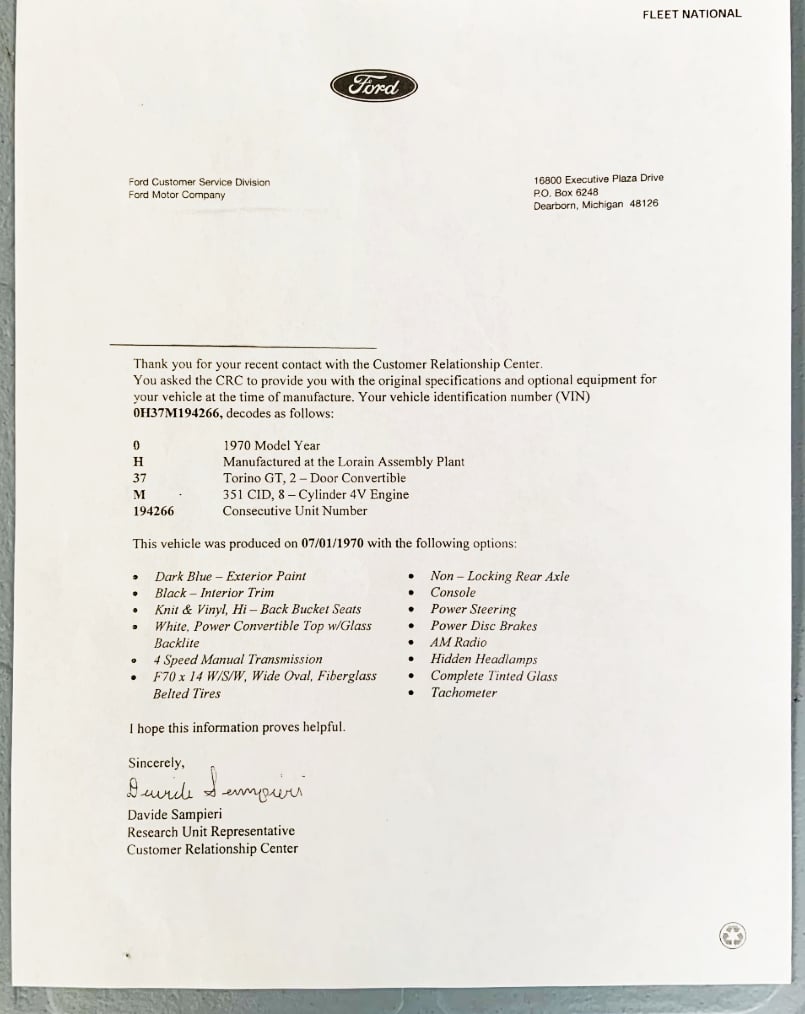
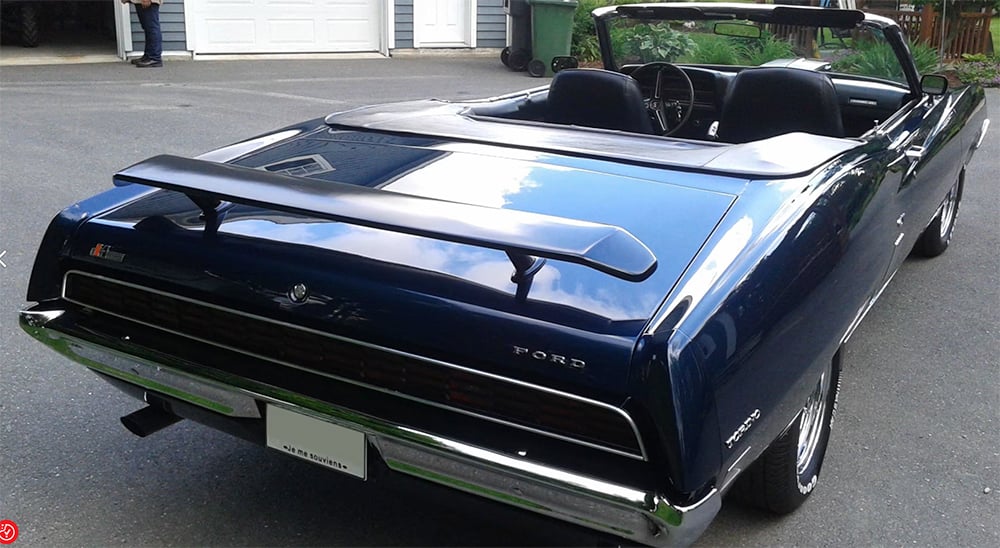
Above and below: 1970 Torino GT convertible with 351 four barrel carb equipped V8 and four-speed manual transmission - sold at Mecum Auctions sale at Kissimmee, Florida 2024 for $62,700, VIN: 0H37M194266 (photos courtesy of Mecum Auctions) - Based upon all of the provided documentation (Marti Report, door tag, and confirmation letter from Ford Motor Company confirming the equipment on the 1970 Torino GT convertible), this droptop GT is a real winner and a real looker.
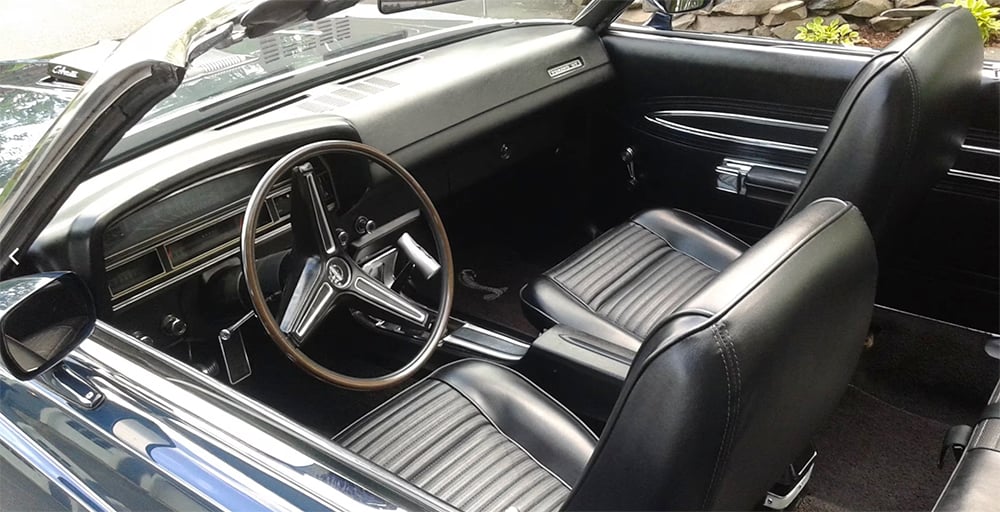
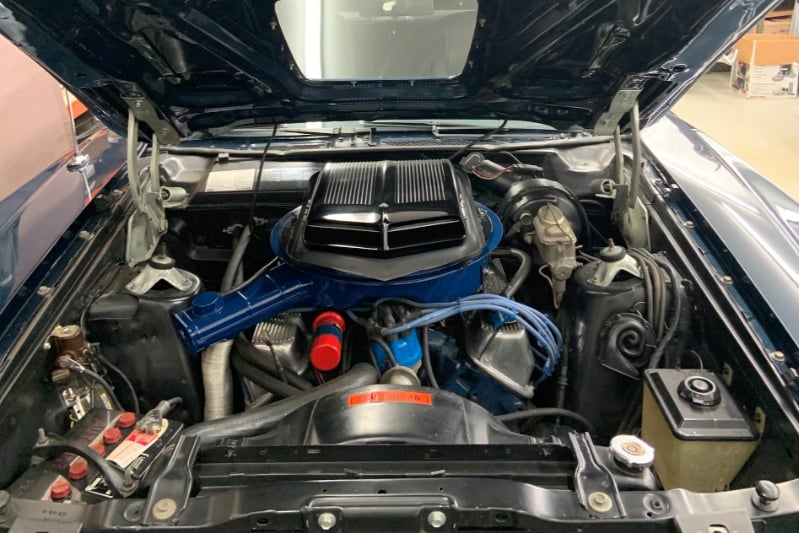
Ford redesigned its intermediates for 1970, introducing dramatic new sheet metal and placing Torino at the center of the lineup. The Torino Cobra, Torino GT, and formidable 429 Cobra Jet engines helped define the model's performance peak.
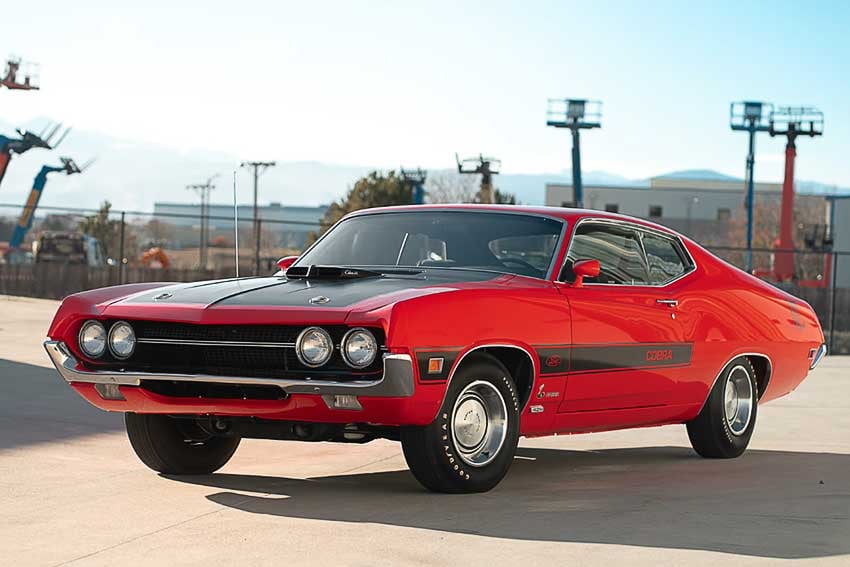
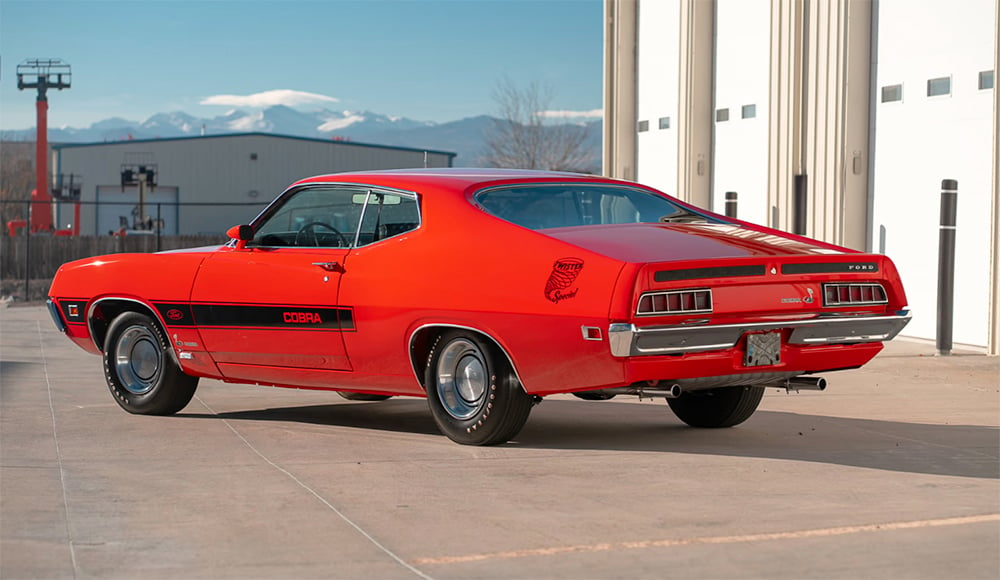
Above and below: 1970 Ford Torino Cobra Twister Special - VIN: 0A38J131604, sold at Kissimmee, Florida 2025 Mecum Auctions event for $159,500 (photos courtesy of Mecum Auctions)
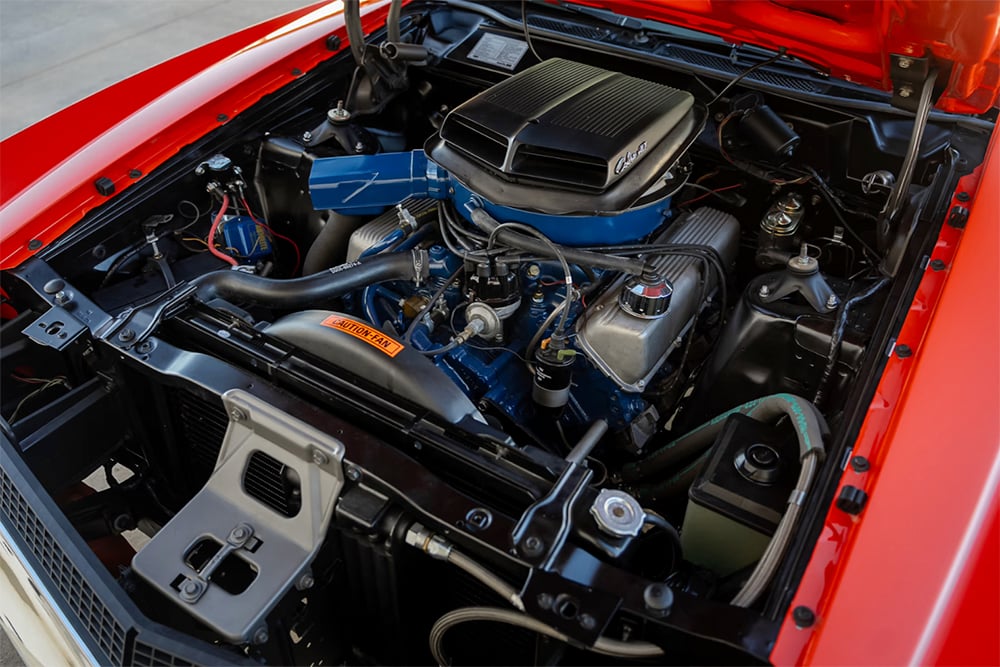
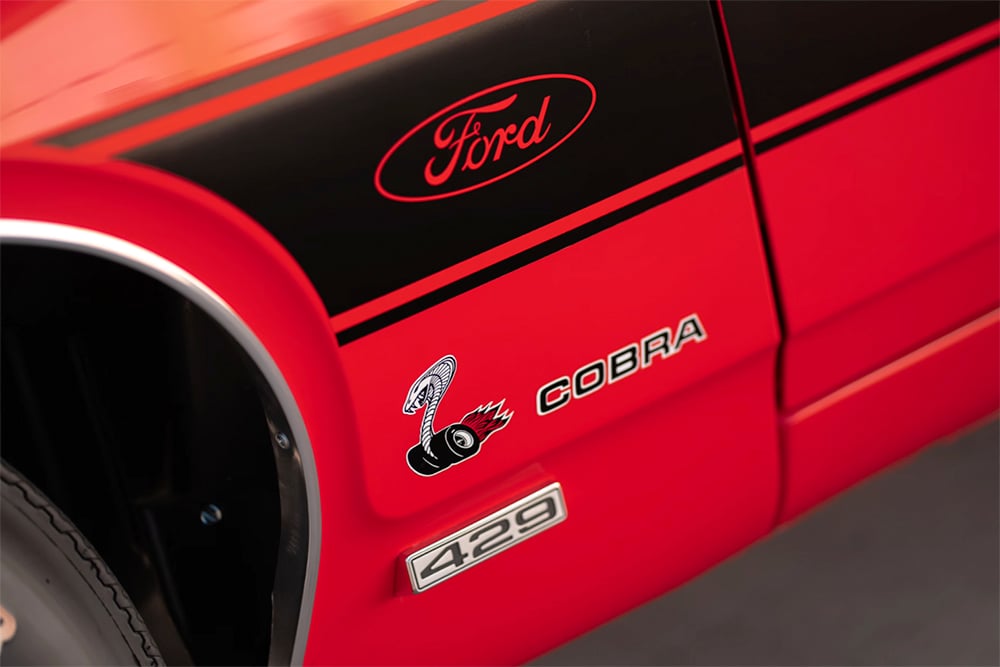
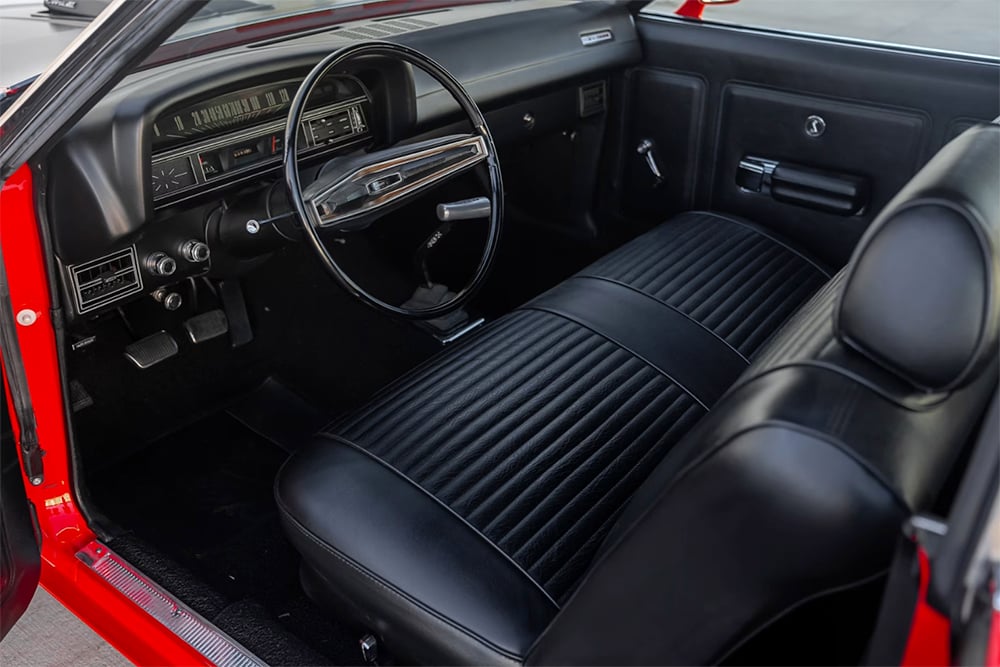
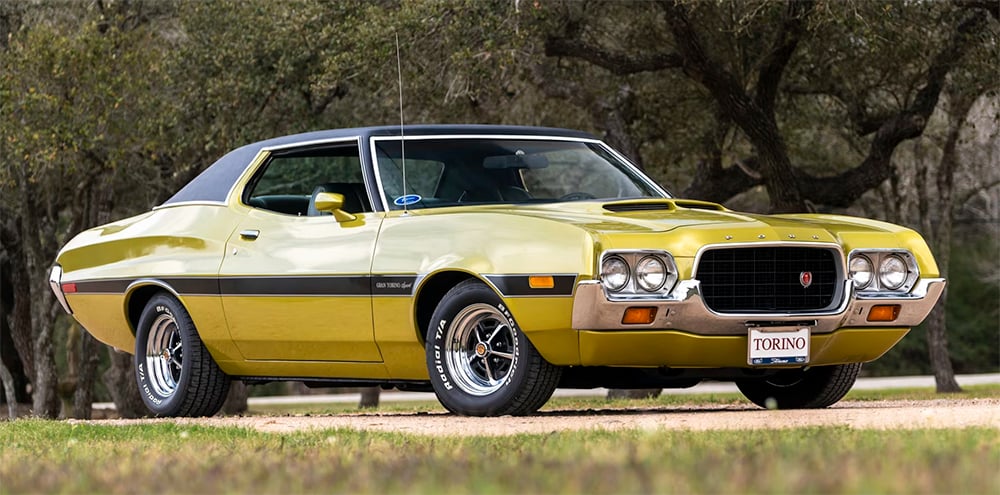
Above and below: 1972 Gran Torino - sold at Mecum Auctions Houston, Texas - VIN: 2A38H253127, 2021 event for $30,800 (photos courtesy of Mecum Auctions)
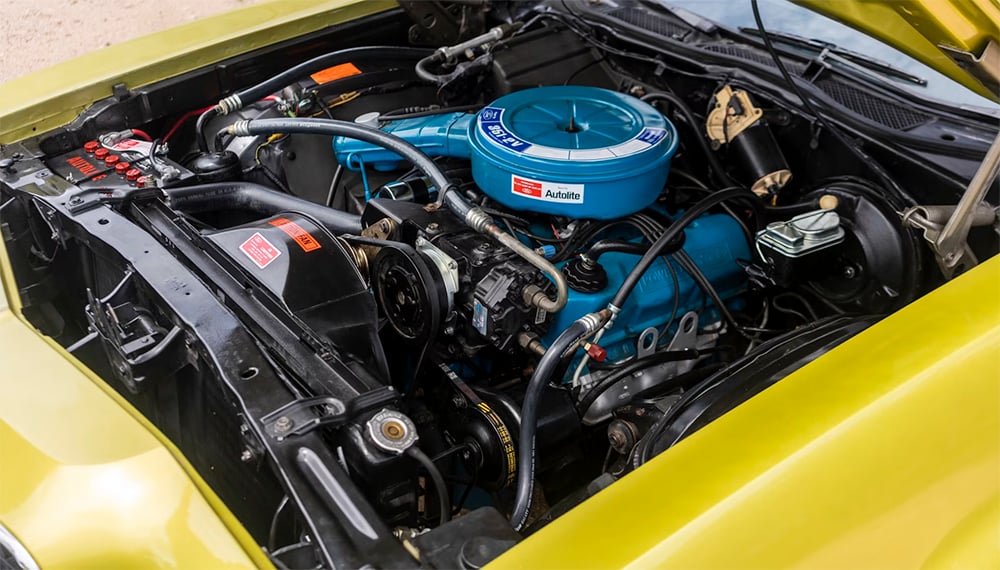
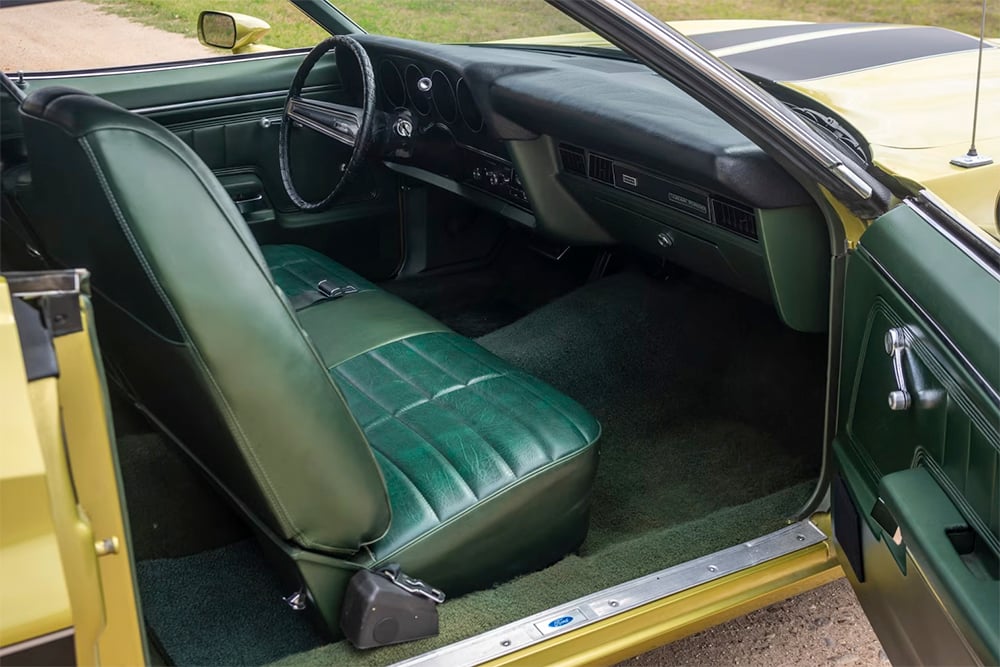
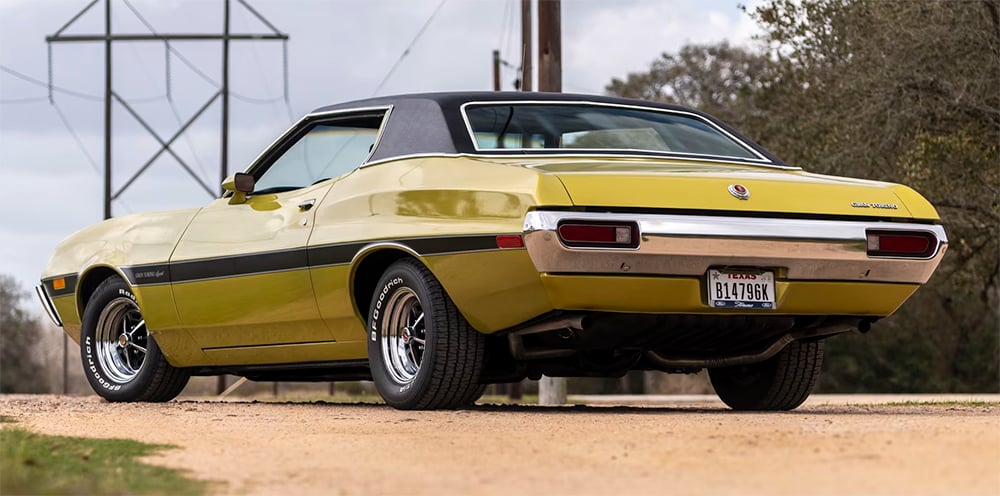
A substantial redesign brought a new body and chassis architecture. The Gran Torino Sport preserved a measure of Ford's muscle-car spirit, although emissions requirements, insurance costs, and changing market conditions were transforming the American performance landscape.
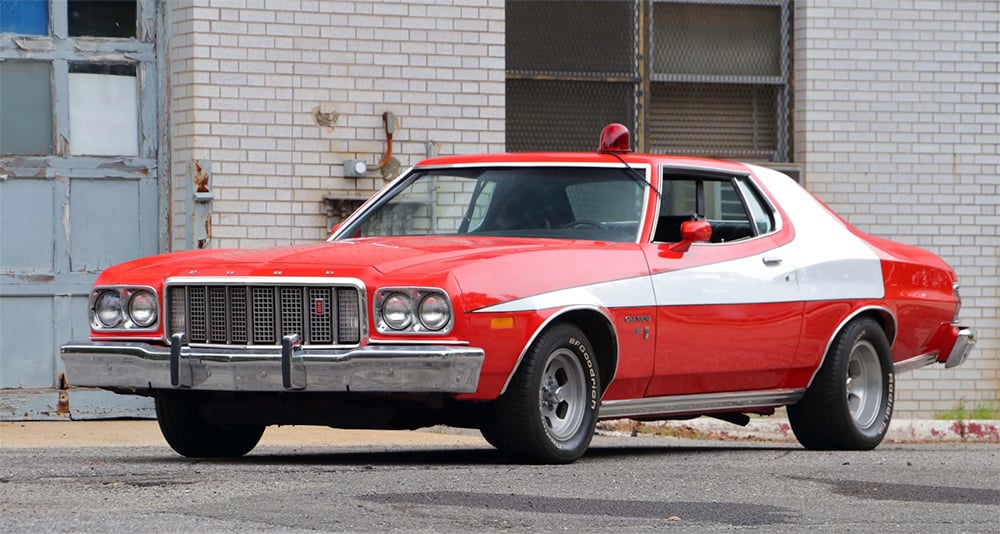
Above and below: For the filming of the popular Starsky & Hutch television show in the mid-1970's, 1974, 1975, and 1976 Gran Torinos were used. These photos show a 1974 Gran Torino Starsky & Hutch promotional vehicle, built by the famous George Barris, that sold at the Harrisburg, Pennsylvania Mecum Auctions event for $27,500 (photos courtesy of Mecum Auctions)
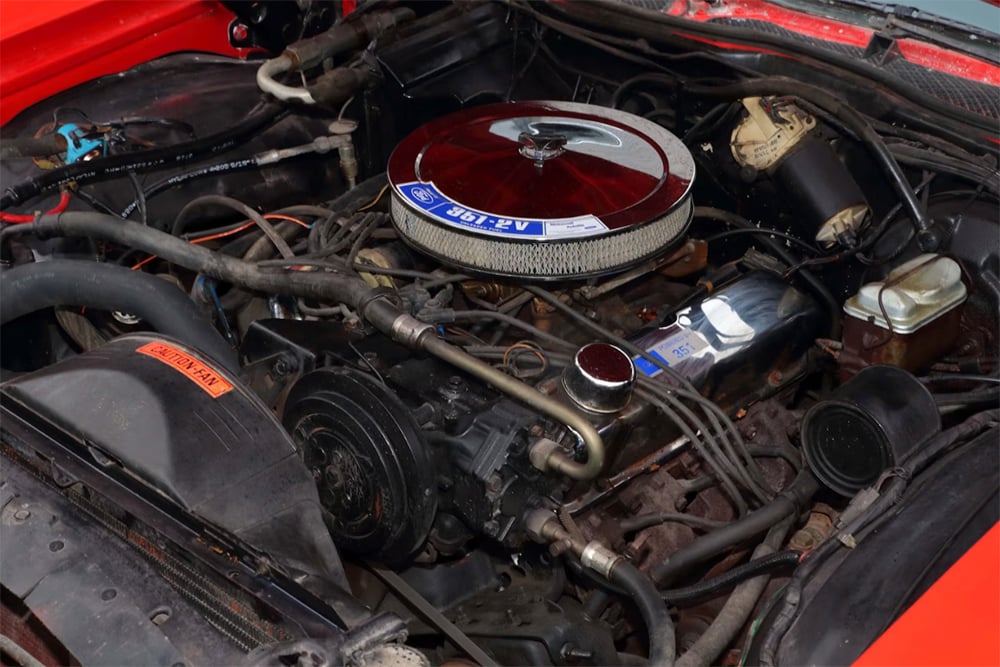
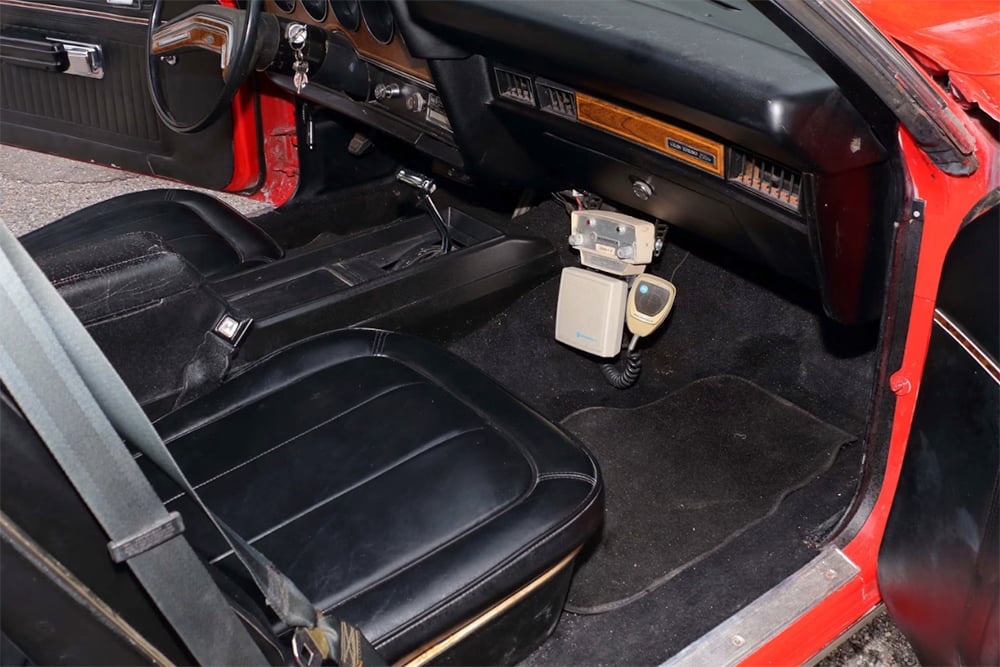
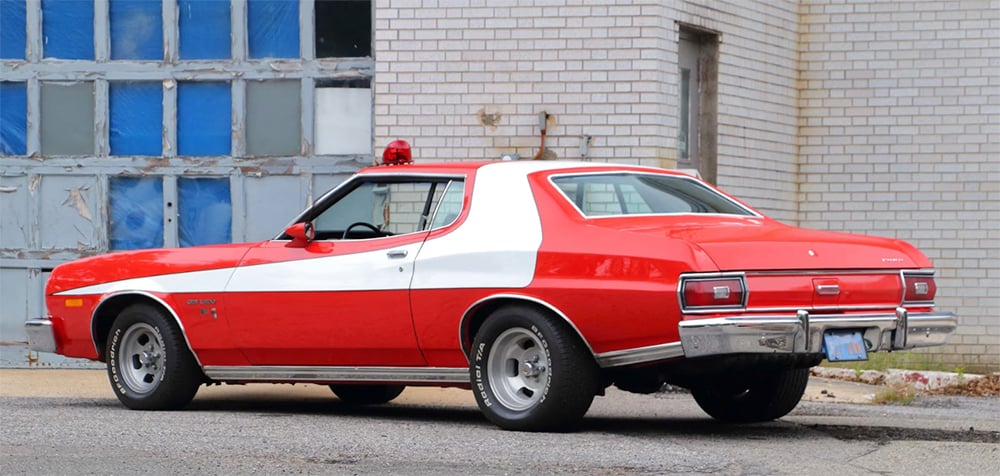
By the mid-1970s, the Torino had evolved into a larger personal and family automobile. V8 engines remained available, but comfort, styling, and everyday drivability took precedence over quarter-mile heroics. The Torino nameplate concluded after the 1976 model year.
Where to Find the VIN on a 1968–1976 Ford Torino
Before we begin translating numbers and letters, we need to locate the vehicle's identification information.
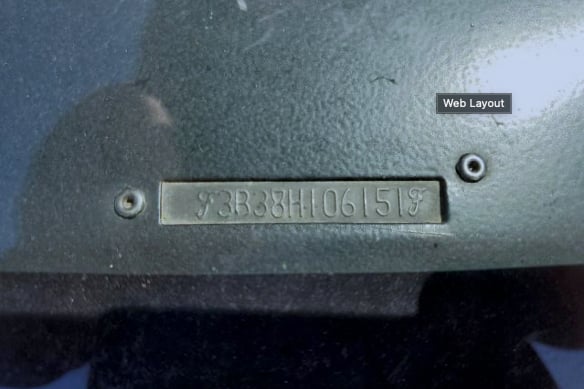
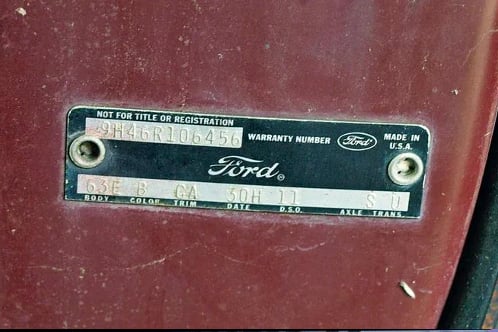
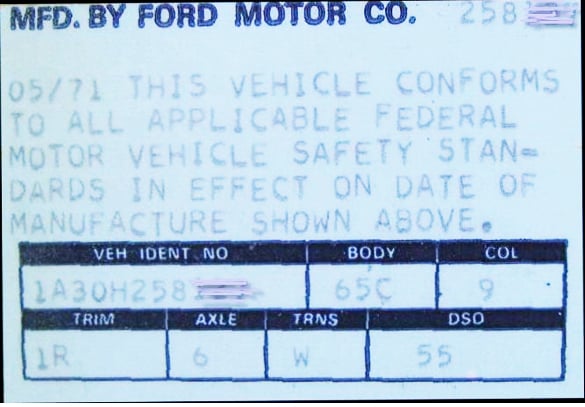
Above: VIN at base of dash panel underneath the windshield, door tag, and vehicle certification label
For these model years, the primary VIN can be found on the instrument panel, visible through the windshield. Ford also provided identification information on the driver's door area, with the precise format and attachment method varying by year.
The key places to inspect are the dashboard VIN plate and the driver's door data plate or certification label. On a car undergoing major restoration, additional body identification stampings may also be useful, although their location and accessibility vary.
Compare the visible VIN with the vehicle's title and registration. If the car has been repainted or restored, examine the identification plates for evidence of alteration, replacement, or damage.
A replaced driver's door doesn't necessarily indicate wrongdoing. After all, these cars are approaching 50 to 60 years of age. Nevertheless, discrepancies deserve investigation before purchasing a supposedly rare factory muscle car.
Understanding Ford's 11-Character VIN
Ford passenger cars of this era used an 11-character vehicle identification number.
A useful example is a documented 1971 Torino GT convertible carrying VIN 1H37H139090. Its Deluxe Marti Report identifies the car as a Lorain-built Torino GT convertible with a 351-cubic-inch two-barrel V8.
DOCUMENTED 1971 TORINO GT VIN
1
Year
H
Plant
37
Series
H
Engine
139090
Sequence
Complete VIN: 1H37H139090
| VIN position | Identification |
| First character | Model year |
| Second character | Assembly plant |
| Third and fourth | Body series/model |
| Fifth character | Factory engine designation |
| Last six characters | Consecutive unit number |
The VIN is our starting point, not the end of the investigation. Ford's period identification literature confirms this general layout for 1970–1972 passenger cars.
Model-year identification codes
| Model year | First VIN character |
| 1968 | 8 |
| 1969 | 9 |
| 1970 | 0 |
| 1971 | 1 |
| 1972 | 2 |
| 1973 | 3 |
| 1974 | 4 |
| 1975 | 5 |
| 1976 | 6 |
Here's a detail worth remembering: the VIN identifies the model year, not necessarily the calendar year in which the car was assembled. A 1971 Torino might have been built during the latter part of 1970.
That distinction becomes important when researching production changes and identifying original equipment.
Ford Torino Assembly Plant Codes
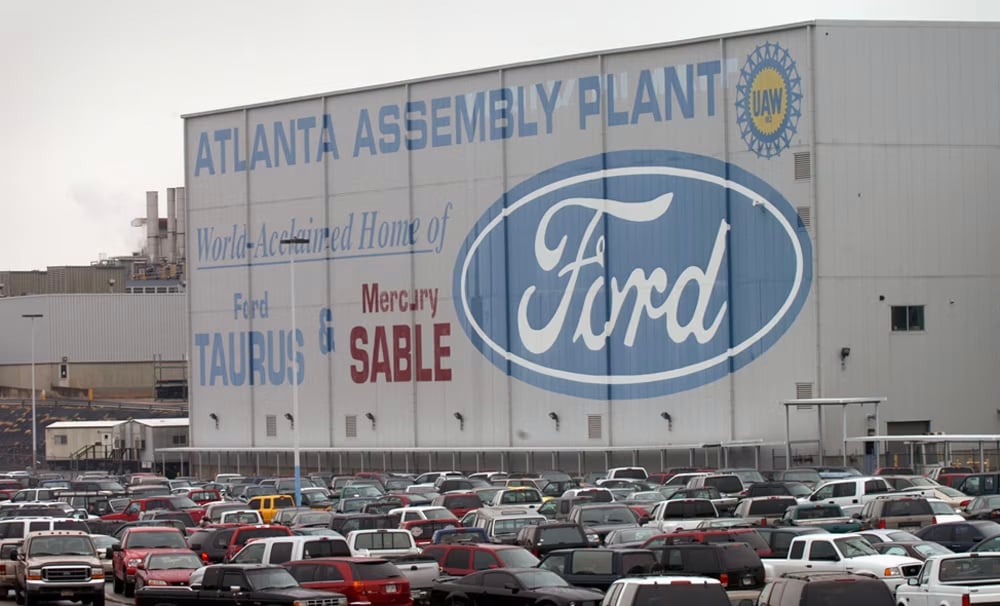
Above: The Ford assembly plant, located just south of Atlanta near the Hartsfield-Jackson International Airport, makes the Taurus and used to produce the mighty Torino, which is being phased out (image from 2008 - Barry Williams / Getty Images file).
The second VIN character identifies the Ford assembly plant assigned to manufacture the vehicle.
The following are important assembly-plant codes encountered in Ford passenger-car identification references from this era. Not every plant built Torinos in every model year.
| Code | Assembly plant |
| A | Atlanta, Georgia |
| F | Dearborn, Michigan |
| G | Chicago, Illinois |
| H | Lorain, Ohio |
| K | Kansas City, Missouri |
| N | Norfolk, Virginia |
| R | San Jose, California |
| T | Metuchen, New Jersey |
| U | Louisville, Kentucky |
The plant code should be checked against the specific model year and body series. A code that appears in a general Ford reference doesn't automatically mean that plant produced every Torino variation.
Decoding Ford Torino Body Series and Model Codes
The third and fourth characters of the VIN are especially interesting because they help establish which model Ford intended to build.
These are not the same as the three-character BODY codes on the door data plate.
For example, a documented 1971 Torino GT convertible has 37 in its VIN, while its door data plate identifies the body configuration as 76F.
That's why we need both identifiers.
The 1968–1969 Fairlane and Torino years
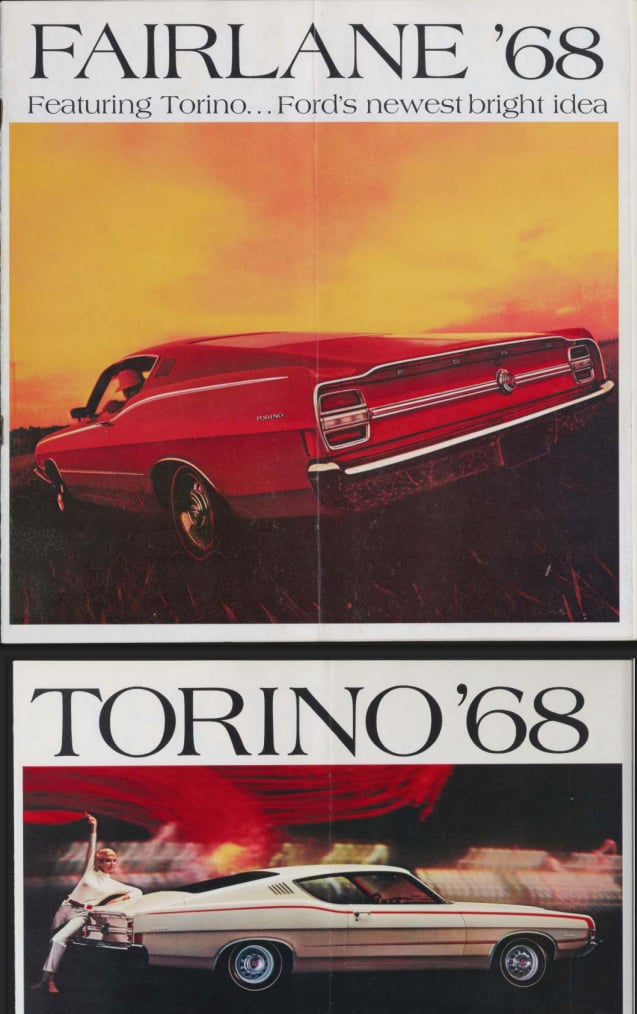
Above: The first two pages of the 1968 Ford Fairlane brochure, where the Torino is introduced - The Ford Heritage Vault is a great resource for learning more about the glorious Ford, Lincoln, and Mercury models from Ford's illustrious past (photo courtesy of the Ford Heritage Vault).
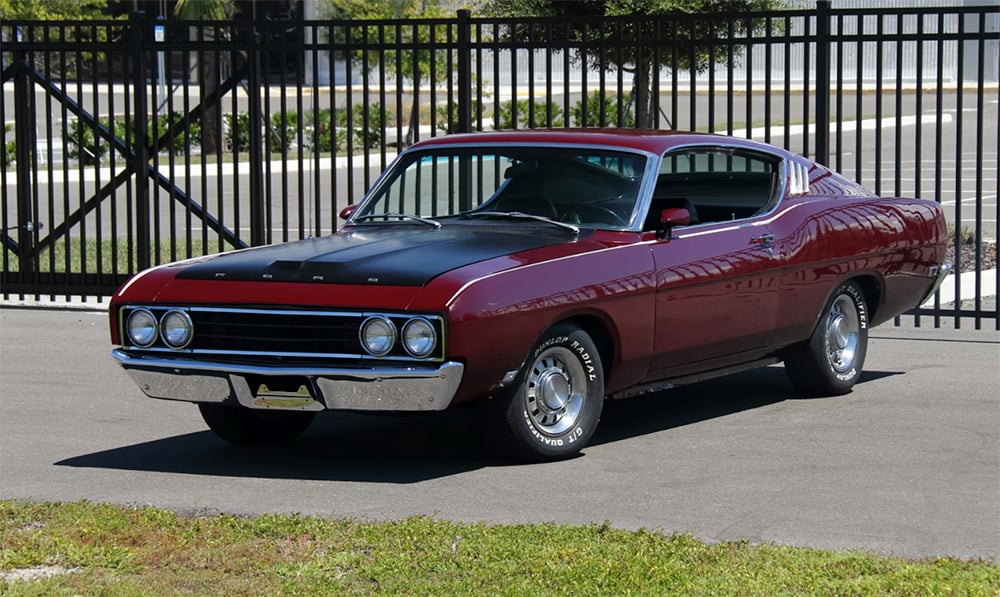
Above: A 1969 Torino Talladega, one of 750 produced, VIN: 9A46Q201887, sold at Mecum Auctions Kissimmee, Florida 2024 event for $73,700 (photo courtesy of Mecum Auctions).
During these early years, the Fairlane and Torino shared much of their engineering and model identification structure.
The 1968 lineup included Fairlane, Fairlane 500, Torino, Torino GT, and Torino Squire models. Among the more interesting VIN body-series codes were:
| 1968 VIN series code | Model |
| 30 | Fairlane two-door hardtop |
| 31 | Fairlane four-door sedan |
| 32 | Fairlane station wagon |
| 34 | Fairlane 500 four-door sedan |
| 37 | Fairlane 500 station wagon |
| 38 | Torino Squire station wagon |
| 40 | Torino two-door hardtop |
| 41 | Torino four-door sedan |
| 42 | Torino GT fastback |
| 43 | Torino GT convertible |
| 44 | Torino GT formal-roof hardtop |
These entries are drawn from a 1968 Ford identification reference; the complete body-series tables should be treated as model-year-specific, particularly for 1969 and later.
| VIN series code | Ford model | Factory body style |
|---|---|---|
| 30 | Fairlane | Two-door formal-roof hardtop |
| 31 | Fairlane | Four-door sedan |
| 32 | Fairlane | Four-door station wagon |
| 33 | Fairlane 500 | Two-door formal-roof hardtop |
| 34 | Fairlane 500 | Four-door sedan |
| 35 | Fairlane 500 | Two-door SportsRoof fastback |
| 36 | Fairlane 500 | Convertible |
| 37 | Fairlane 500 | Four-door station wagon |
| 38 | Torino Squire | Four-door station wagon |
| 40 | Torino | Two-door formal-roof hardtop |
| 41 | Torino | Four-door sedan |
| 42 | Torino GT | Two-door SportsRoof fastback |
| 43 | Torino GT | Convertible |
| 44 | Torino GT | Two-door formal-roof hardtop |
| 45 | Cobra | Two-door formal-roof hardtop |
| 46 | Cobra | Two-door SportsRoof fastback |
Source: Ford Motor Company's 1969 Car Shop Manual, Volume One, Vehicle Identification, section 01-01-04.carmanualsonline.info
Note: The legendary 1969 Ford Torino Talladega also carried the 46 body-series designation. However, the 46 code alone doesn't establish that a vehicle is an authentic Talladega. Production Talladegas used the Atlanta assembly-plant code A and the 428 Cobra Jet Q-code engine designation, with additional documentation needed to establish authenticity. Talladegas and Spoilers Registry
The Torino GT fastback is especially significant. Its sloping roofline wasn't simply a styling exercise. Ford was deeply involved in NASCAR competition, and aerodynamic efficiency was becoming a major consideration in stock-car racing.
The Torino Talladega, introduced for 1969, pushed that philosophy even further with a modified front end designed to improve high-speed aerodynamics.
These two-digit VIN body-series codes with the three-character BODY codes on Ford's door data plate. For example, a 1969 Torino GT SportsRoof has VIN series 42, but its door BODY code depends on its factory seating configuration.
The 1970–1971 Torino and Cobra years
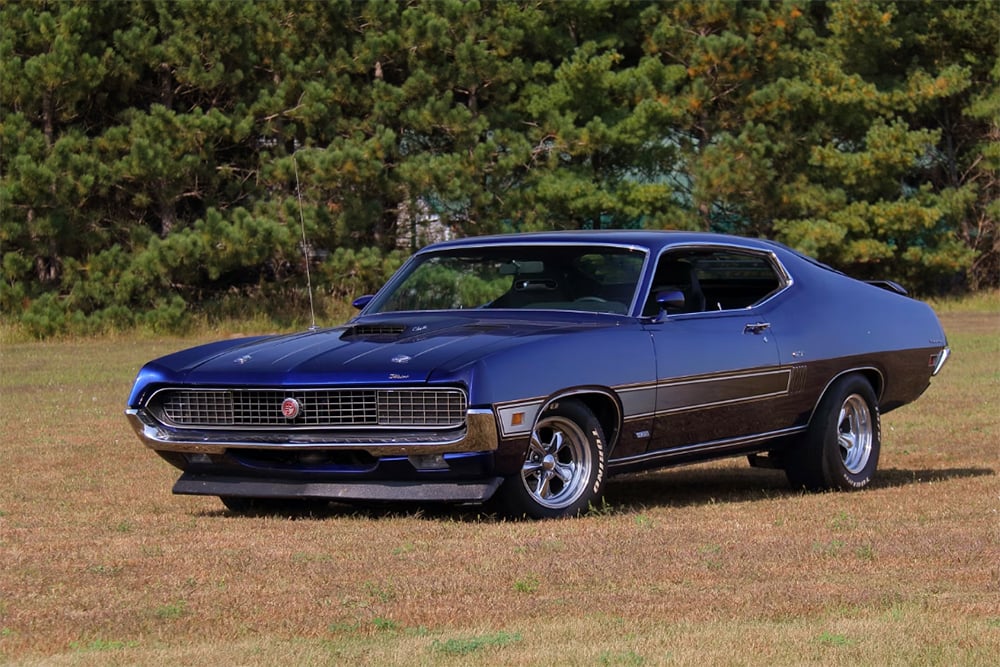
Above and below: This 1970 Torino GT with some sweet restomod touches, VIN: 0A35M237932, sold at Mecum Auctions Indy Fall Special 2025 for $60,500 (photos courtesy of Mecum Auctions).
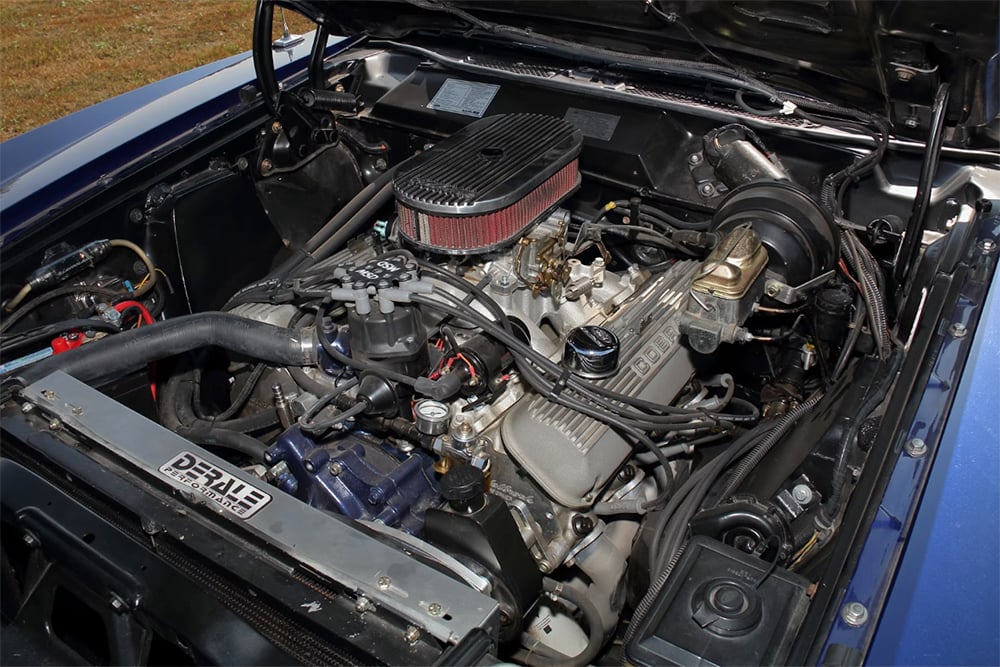
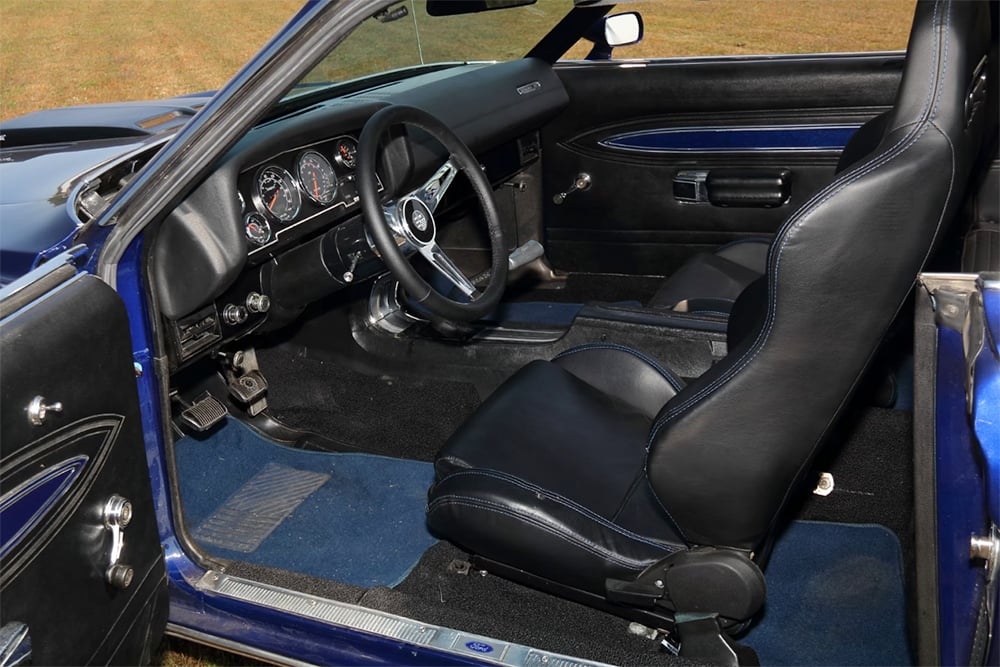
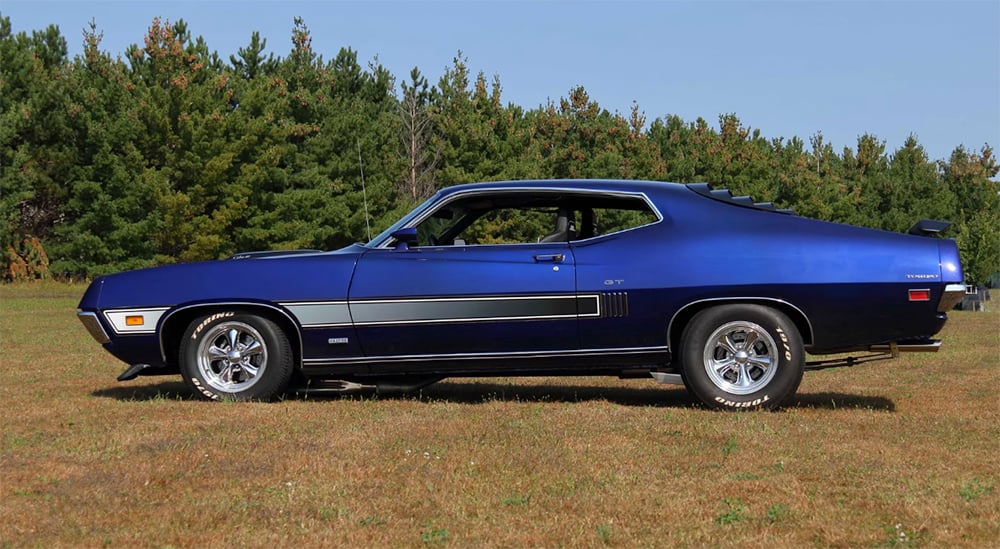
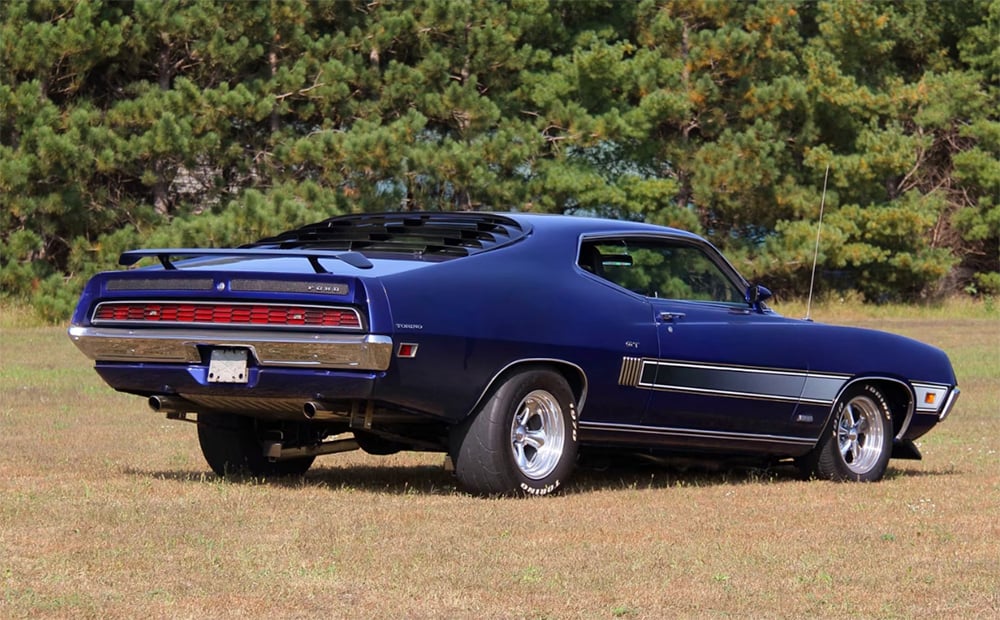
The 1970 redesign brought one of the most aggressive-looking intermediates of the muscle-car era.
With its pronounced body contours, wide stance, and available high-performance engines, the Torino Cobra was a serious contender in the muscle-car wars.
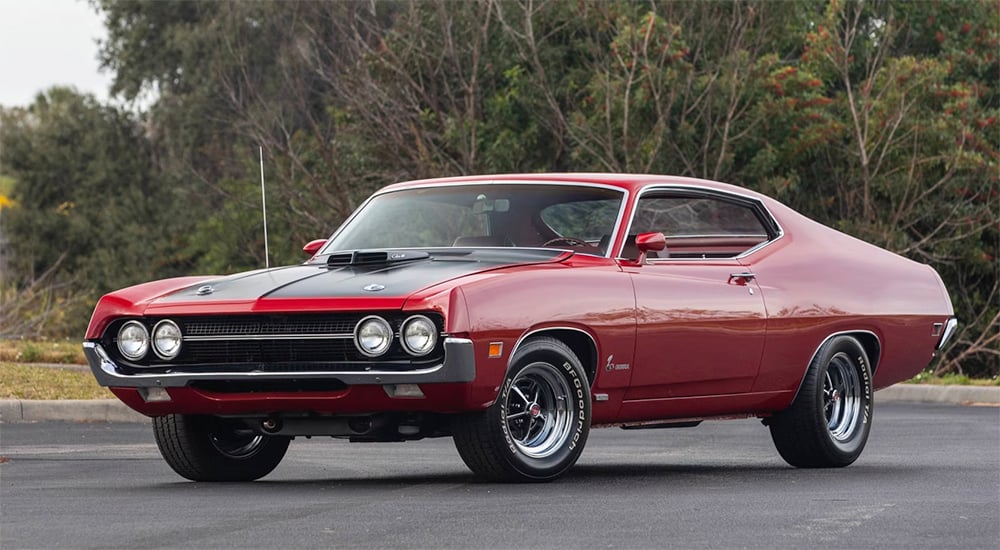
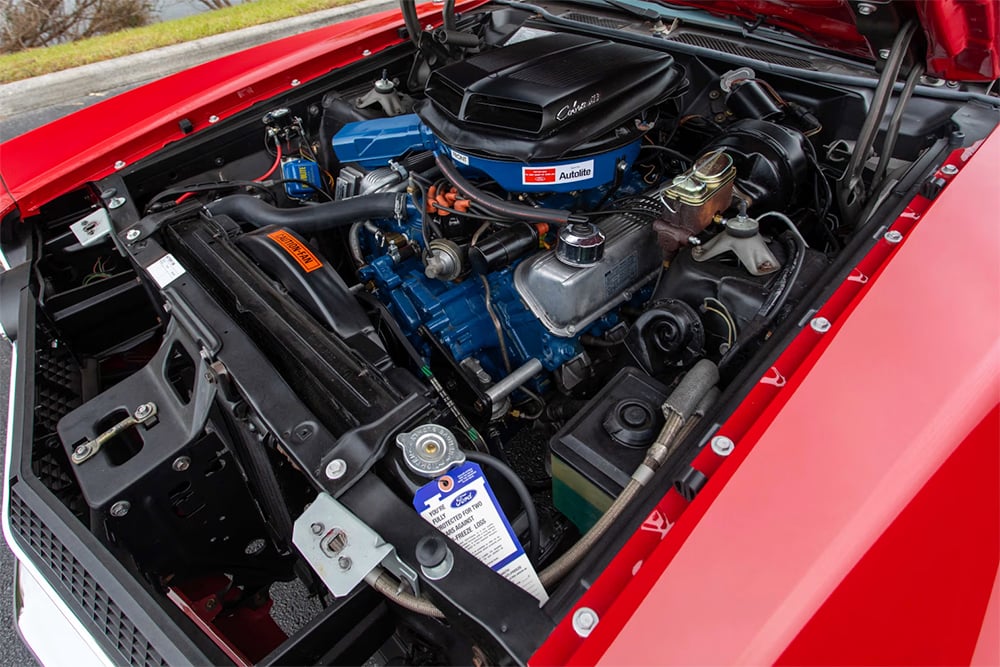
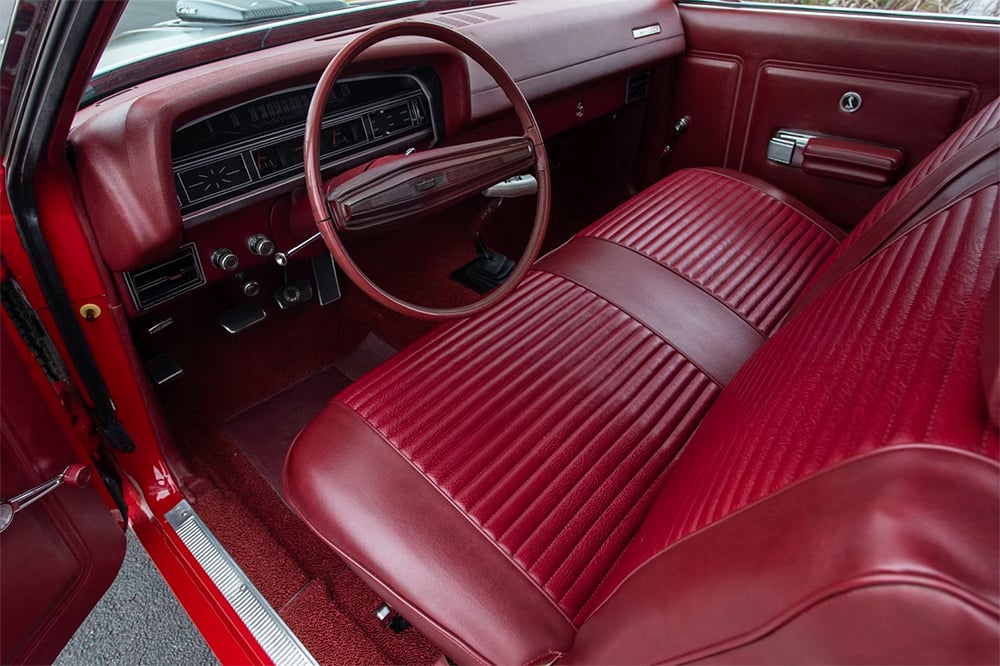
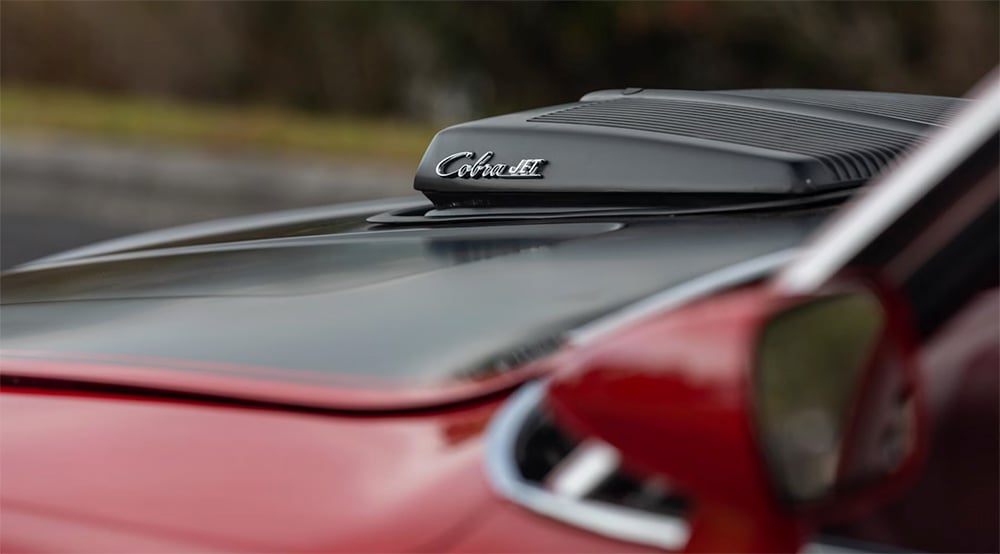
Above and below: This 1970 Torino Cobra with a 429 Cobra Jet V8 that's backed by a factory four-speed manual and is equipped with the Factory Drag Pack, sold at the Mecum 2021 Glendale, Arizona event for $68,200, VIN: 0A38J163515. Enjoy the stunning even light or magic light photography here and by clicking the link just above (awesome photos courtesy of Mecum Auctions).
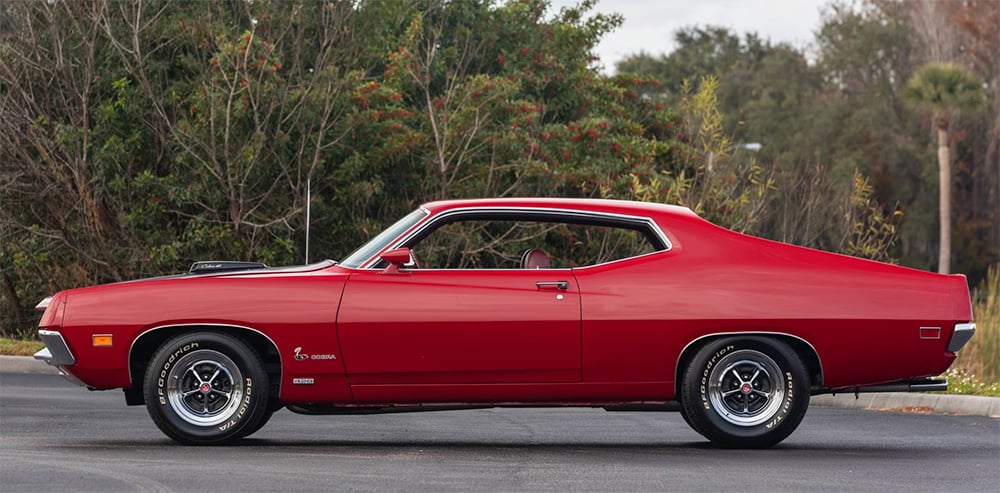
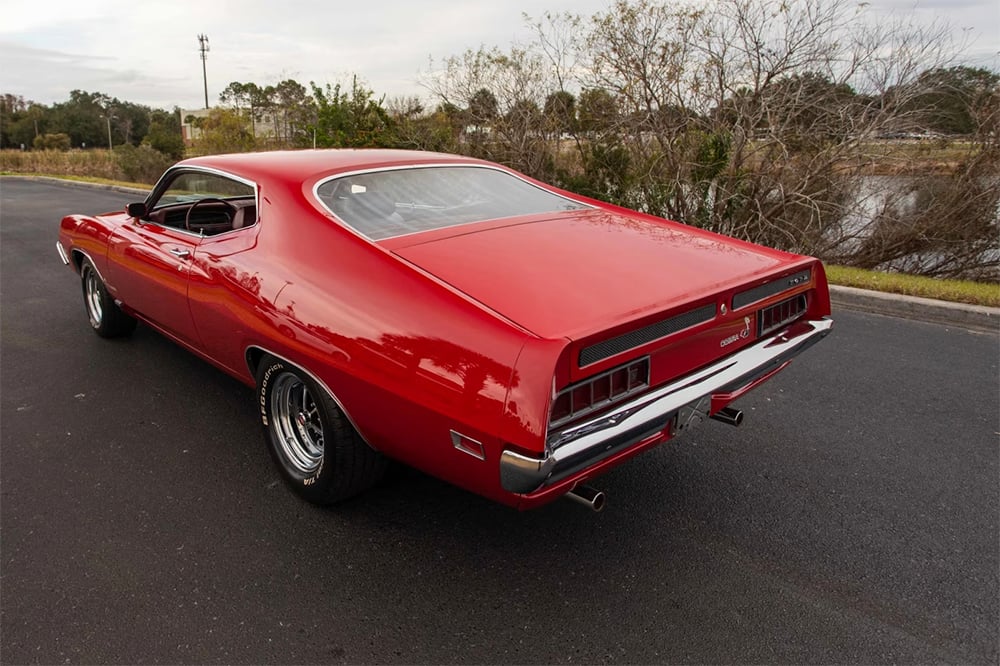
By 1971, Ford had further reorganized its intermediate lineup, with the Fairlane name disappearing from the passenger-car range.
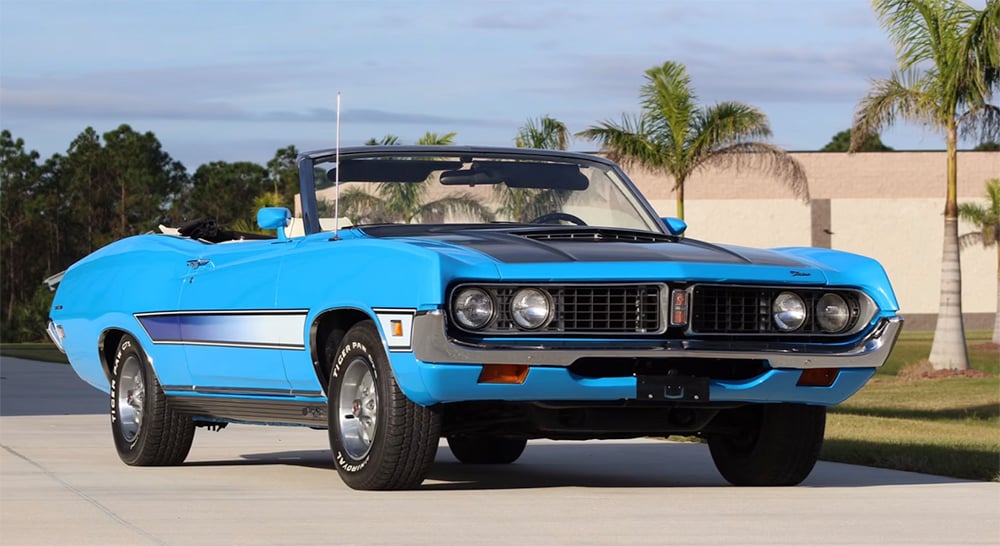
Above: 1971 Torino convertible, VIN: 1H37M194474, sold at Mecum Auctions Kissimmee, Florida 2018 event for $42,900 (photo courtesy of Mecum Auctions)
The critical lesson for decoding these cars is that a Cobra, Torino GT, and ordinary Torino must be distinguished using the correct year's body-series information, rather than by relying on stripes, badges, hood scoops, or an engine swap.
A beautiful restoration can recreate the appearance of a rare performance model. Only the correct identification evidence can establish how Ford originally built it.
The 1972–1976 Gran Torino years
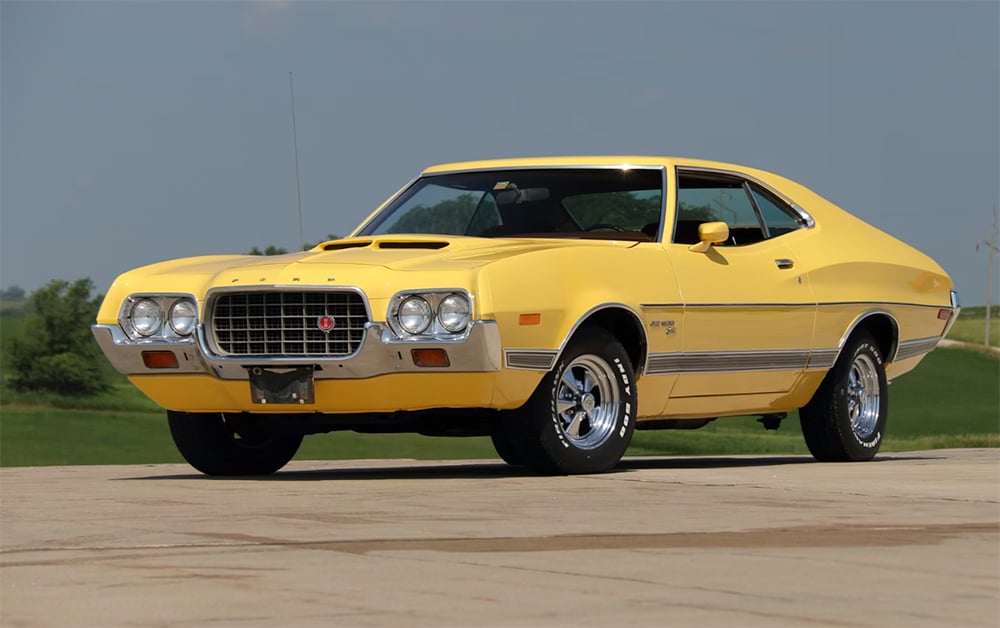
Above: 1972 Gran Torino, VIN: 2A35H224785, sold at the Mecum Auctions Kissimmee, Florida Summer Special 2023 event for $37,400 (photo courtesy of Mecum Auctions)
Beginning in 1972, Ford introduced a substantially redesigned Torino with new styling, a different chassis, and an expanded Gran Torino identity.
The door data plate provides especially useful body-style information for these cars.
The following examples illustrate several factory BODY codes for 1973 and 1974:
| Door BODY code | Model/body style |
| 53B | Torino four-door sedan |
| 65B | Torino two-door hardtop |
| 71B | Torino four-door station wagon |
| 53D | Gran Torino four-door sedan |
| 65D | Gran Torino two-door hardtop |
| 71D | Gran Torino four-door station wagon |
| 71K | Gran Torino Squire wagon |
| 63R | Gran Torino Sport fastback (1973) |
| 65R | Gran Torino Sport hardtop |
| 53K | Gran Torino Brougham four-door sedan |
| 65K | Gran Torino Brougham two-door hardtop |
| 65M | Gran Torino Elite two-door hardtop (1974) |
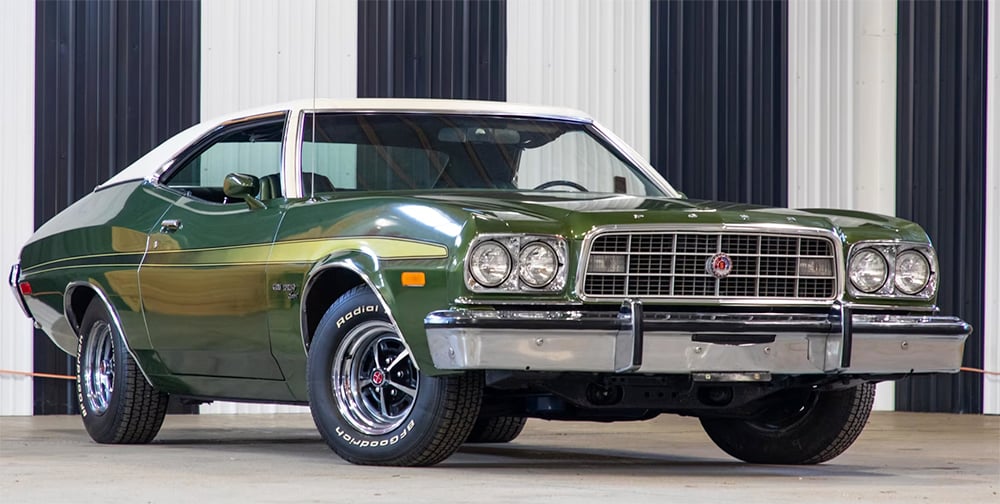
Above: 1973 Gran Torino with a 351 cubic inch V8 backed by a four-speed manual (rare), VIN: 3H35Q172370, sold at Mecum Auctions Indy 2019 event for $25,300 (photo courtesy of Mecum Auctions)
The 1973 data-plate reference lists both 63R and 65R Gran Torino Sport bodies. The 1974 reference lists 65R but not 63R, reflecting the disappearance of the SportsRoof fastback configuration.
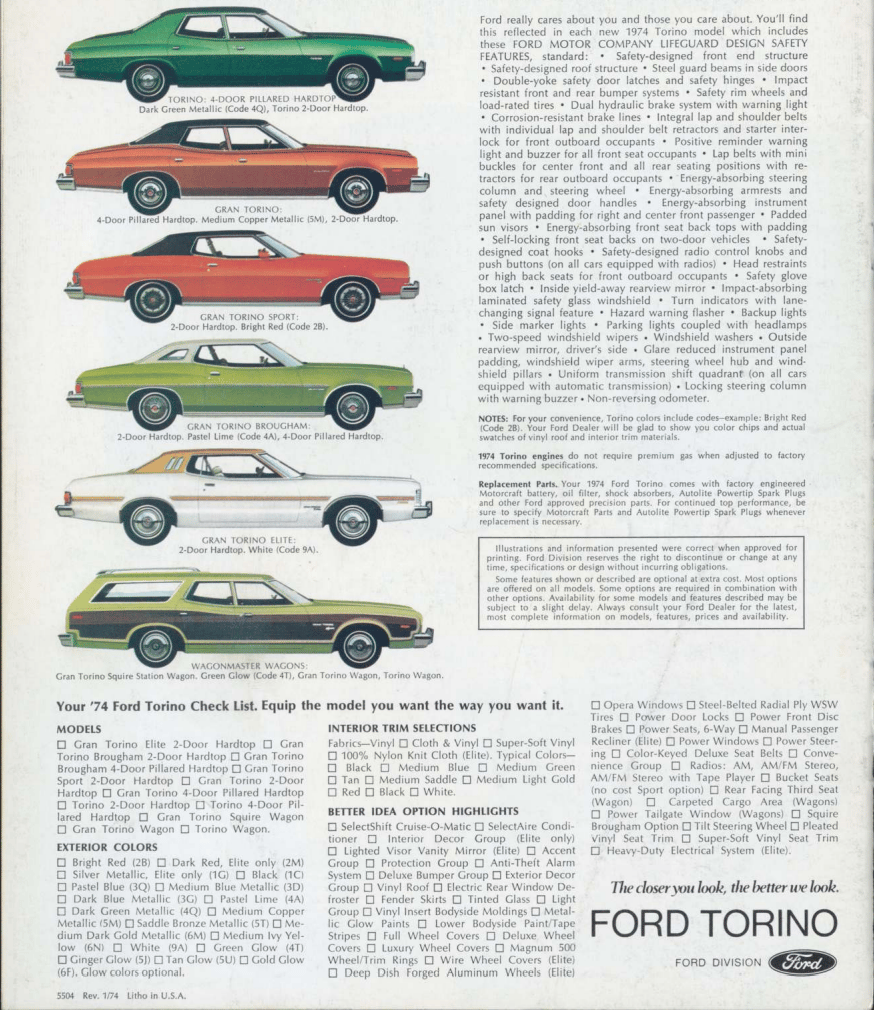
Above: Here's the last page of the 1974 Ford Torino brochure showing the various '74 Torino models, as well as exterior hues, interior colors and trim selections, and options. Get yourself to the Ford Heritage Vault, if you're also a fan of automobilia (photo courtesy of the Ford Heritage Vault).
One important wrinkle: the Torino Elite became a separate Ford Elite nameplate for 1975. It shouldn't automatically be counted as a Torino for the final two years.
Ford Torino Engine Codes: Where the Horsepower Story Begins
The fifth character of the VIN identifies the engine originally designated for the vehicle.
For muscle-car enthusiasts, this is often the first character they look for after confirming the model year.
A factory big-block Cobra Jet is considerably more interesting to many collectors than a Torino originally equipped with a small-block V8, even when the two cars now look virtually identical.
However, Ford's engine-code assignments changed over time. A code from 1969 should never be assumed to carry the same meaning in 1975.
1968–1969: The FE big-block years
Above: 1969 428SCJ Ford big-block V8 mill (code R) in the '69 black over read 1969 Torino fastback above (photo courtesy of Mecum Auctions)
Among the most desirable engines of this period were Ford's FE-series 390 and 428 V8s.
1968 Ford Fairlane and Torino Engine Codes
| VIN engine code | Engine identification | Factory-rated horsepower |
|---|---|---|
| T | 200-cu.-in. inline-six, one-barrel | 115 HP |
| C | 289-cu.-in. V8, two-barrel (early production) | 195 HP |
| F | 302-cu.-in. V8, two-barrel | 210 HP |
| J | 302-cu.-in. V8, four-barrel | 230 HP |
| Y | 390-cu.-in. V8, two-barrel | 265 HP |
| S | 390-cu.-in. V8, four-barrel GT | 325 HP |
| Q | 428-cu.-in. V8, four-barrel, non-Ram Air application | 335 HP |
| R | 428 Cobra Jet V8, four-barrel, Ram Air | 335 HP |
Note: Horsepower figures are period SAE gross ratings. Engine availability varied by model and production date.
1968 notes: The 289 two-barrel was an early-production engine before the 302 became the principal small-block offering. Ford introduced the 428 Cobra Jet during the 1968 model year, making its availability dependent on production timing. The Q- and R-code 428 entries should be checked against the specific Fairlane/Torino application and build date rather than assumed to have been offered throughout the year.
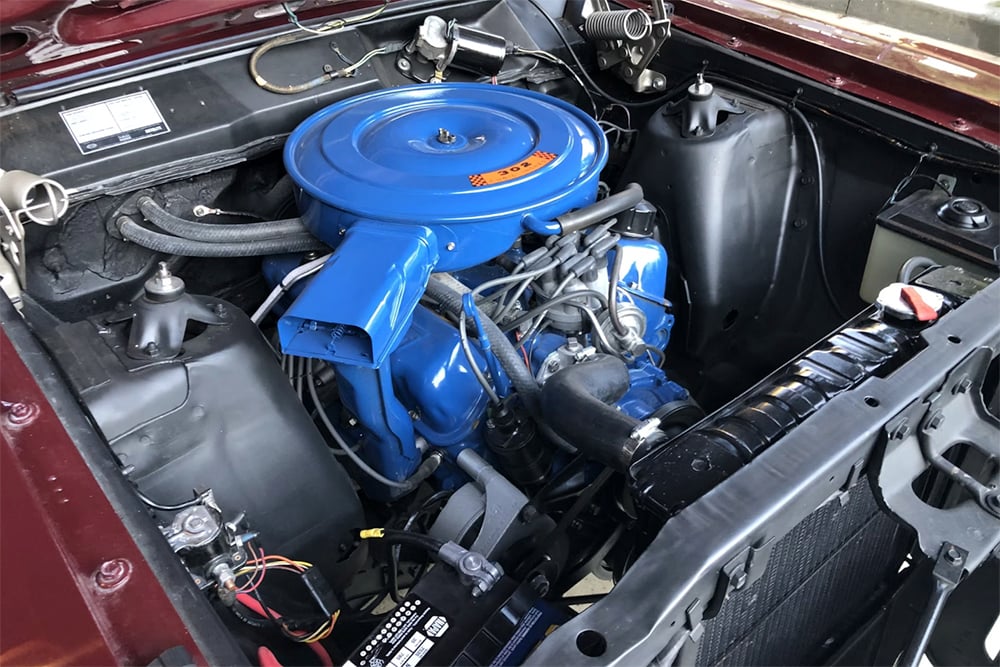
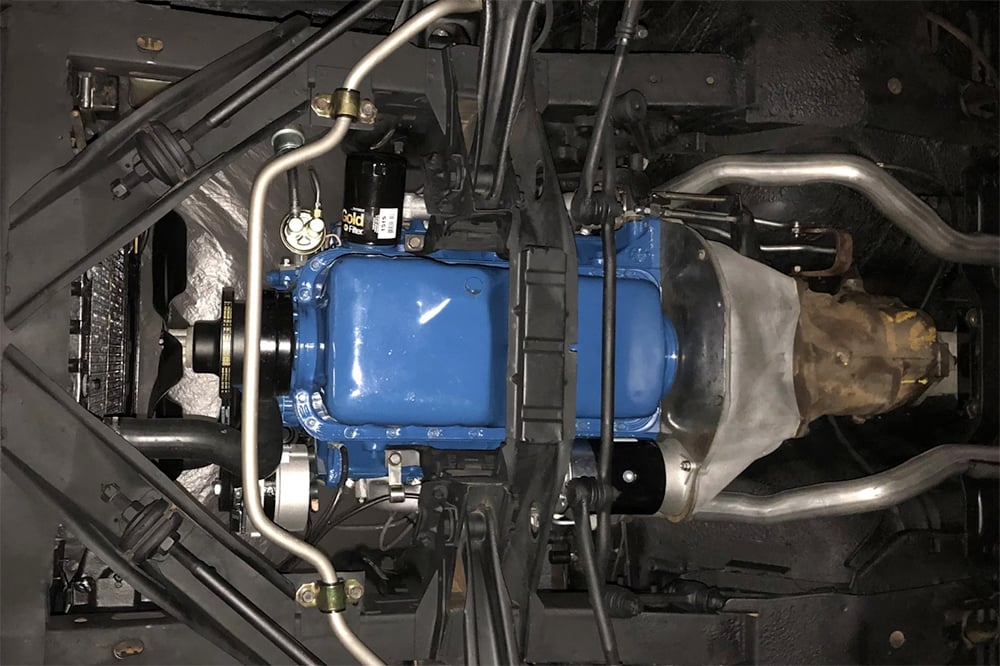
Above and below: Original Ford 302 small block V8 two-barrel carb (code F) in a 1969 Torino (photos courtesy of Mecum Auctions)
1969 Ford Fairlane and Torino Engine Codes
| VIN engine code | Engine identification | Factory-rated horsepower |
|---|---|---|
| L | 250-cu.-in. inline-six, one-barrel | 155 HP |
| F | 302-cu.-in. V8, two-barrel | 220 HP |
| H | 351 Windsor V8, two-barrel | 250 HP* |
| M | 351 Windsor V8, four-barrel | 290 HP |
| S | 390-cu.-in. V8, four-barrel | 320 HP |
| Q | 428 Cobra Jet V8, four-barrel, without Ram Air | 335 HP |
| R | 428 Cobra Jet V8, four-barrel, with Ram Air | 335 HP |
*Some Ford period brochures list the 351 two-barrel at 240 HP, while other references list 250 HP. The factory brochure for the specific production period should govern the published rating.
These codes illustrate important Ford engine designations of the period; availability differed by year, body style, and vehicle line. In particular, the Q-code 428 should not be interpreted as a universal Cobra Jet designation without checking the exact model-year application.
The 428 Cobra Jet deserves special attention. Introduced during 1968, it quickly established itself as one of Ford's most formidable street-performance engines.
With its substantial displacement, strong torque output, and competition-inspired engineering, the Cobra Jet transformed well-styled Ford intermediates into serious street machines.
And unlike a hood decal, a correct factory engine code is part of the vehicle's original identification record.
What changed between 1968 and 1969?
The big news for 1969 was Ford's introduction of the 351 Windsor V8, available with either a two-barrel or four-barrel carburetor. The 250-cubic-inch inline-six replaced the smaller 200 as the base six-cylinder engine.
The 1968 289 two-barrel and 302 four-barrel disappeared from the regular 1969 intermediate lineup. Ford also discontinued the 390 two-barrel, retaining the 390 four-barrel as an optional big-block V8.
Meanwhile, the mighty 428 Cobra Jet continued into 1969, most notably as standard equipment in the new Ford Cobra. The 428 remained available in both non-Ram Air and Ram Air configurations, identified by the Q and R VIN engine codes, respectively. Over-Drive-Magazine
1970–1971: The 429 Cobra Jet takes center stage
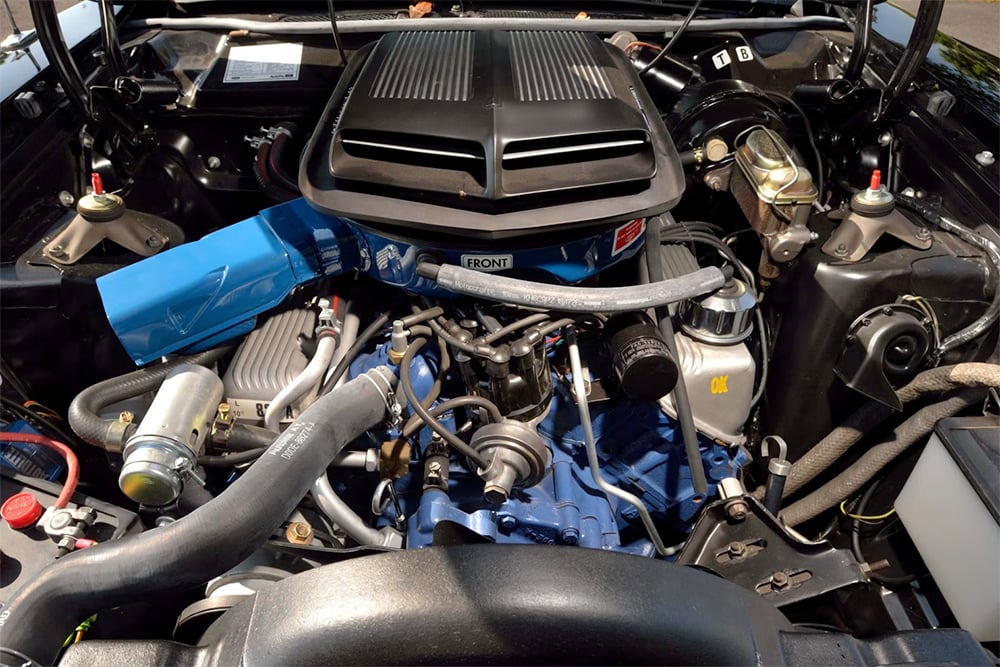
Above: 1970 Torino 429SCJ mill - 429 big-block Ford V8 Super Cobra Jet engine (code J) (photo courtesy of Mecum Auctions)
For 1970, Ford's 385-series 429 V8 became the headline big-block performance engine in the Torino.
| VIN engine code | Engine designation |
| N | 429 standard four-barrel, without Ram Air |
| C | 429 Cobra Jet four-barrel, without Ram Air |
| J | 429 Cobra Jet four-barrel, with Ram Air |
These distinctions are especially important when authenticating a 1970 or 1971 Torino.
The J-code is understandably coveted. After all, few sights are more appealing to a Ford enthusiast than a factory-style shaker assembly rising through the hood of a Torino Cobra.
But here's an essential distinction:
A J-code Torino is not automatically a Super Cobra Jet.
The Super Cobra Jet designation involved additional heavy-duty performance equipment associated with the Drag Pack. That package isn't identified by a separate SCJ character in the VIN.
A C-code Torino could also receive Drag Pack equipment in applicable configurations. For a 1970 car, a factory 3.91 or 4.30 axle designation can be a valuable clue, but factory documentation remains the stronger evidence.
For 1971, production records and period literature require particular care when investigating claims of factory-installed Drag Pack equipment. An engine code alone is insufficient. Research citing Marti Auto Works indicates that although the Drag Pack appeared in 1971 literature and preproduction testing, production records show it was installed only on Mustangs that model year, not production Torinos.
1972–1973: The 351 Cobra Jet and the changing performance landscape
Ford's 1972 Torino redesign coincided with a dramatic shift in the American automotive industry.
Emissions regulations, changing fuel requirements, and insurance costs were reshaping the high-performance market. The industry also transitioned from SAE gross horsepower ratings to SAE net ratings, making direct comparisons between 1971 and 1972 horsepower figures misleading.
Video: The Boss 351 Cleveland Cobra Mill was Special!
The 351 Cleveland four-barrel Cobra Jet became one of the most interesting performance engines in the new Gran Torino.
| Engine code | 1972–1973 engine identification |
| L | 250-cu.-in. inline-six |
| F | 302-cu.-in. two-barrel V8 |
| H | 351-cu.-in. two-barrel V8 |
| Q | 351 Cleveland four-barrel Cobra Jet V8 |
| S | 400-cu.-in. two-barrel V8 |
| N | 429-cu.-in. four-barrel V8 |
| A | 460-cu.-in. four-barrel V8, 1973 police application |
The Q-code 351 Cobra Jet is an especially desirable identification for enthusiasts seeking a factory performance-oriented 1972 or 1973 Torino. The H-code requires further investigation because Ford offered different 351 engine families under the same broad VIN designation.
A 351 Windsor and a 351 Cleveland are not interchangeable from a restoration-parts standpoint. Their cylinder heads, intake manifolds, cooling arrangements, and numerous other components differ.
Consequently, a VIN that identifies a 351 two-barrel V8 doesn't always establish which engine family is physically installed today.
1974–1976: The final Torino engines
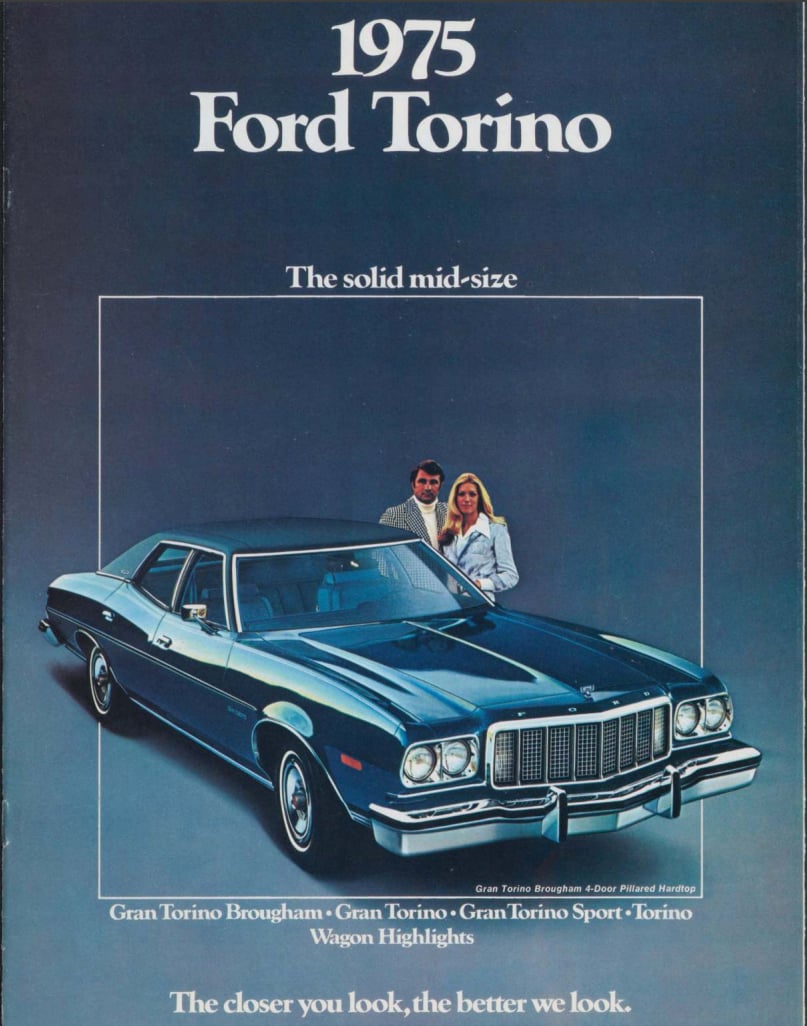
Above: With the cover artwork for the 1975 Ford Torino brochure, one can readily see that the American muscle car days of yore had receded way back into horizon of the rear-view mirror of the early 1970's and the swingin' horsepower wars of the 1960's. That's not a two-door fastback Torino GT coupe on the cover. It's a four-door sedan with a young Yuppie couple looking towards a bright future in the suburbs. Indeed, it almost looks like the 'Six-Million-Dollar Man' (actor Lee Majors) and the 'Six-Million-Dollar Woman' (actress Lyndsey Wagner) poised ready for executive action when they're not fighting crime (photo courtesy of Ford Heritage Vault).
By the mid-1970s, the Torino was primarily a comfortable, substantial American automobile rather than an all-out street-performance machine.
Nevertheless, Ford continued offering a variety of V8 powerplants, including the 351, 400, and 460.
Among the important later engine codes were:
| Code | Engine | Model-year context |
| H | 351 two-barrel V8 | 1975–1976 |
| S | 400 two-barrel V8 | 1975–1976 |
| A | 460 four-barrel V8 | 1975–1976 |
| C | 460 four-barrel Police Interceptor V8 | 1975–1976 police applications |
The H-code can encompass both the 351 Windsor and 351 Modified families, depending on application.
For restorers, that distinction is particularly important. Before ordering major engine components, confirm the actual engine family using casting numbers, external identification features, and appropriate Ford service literature.
A VIN decoder is an excellent starting point. It isn't a substitute for physically identifying the engine.
Decoding the Ford Torino Door Data Plate
If the VIN is the Torino's birth certificate, think of the factory door data plate as a more detailed description of the automobile Ford intended to build.
Depending on the model year, the plate or certification label contains fields identifying the vehicle's body configuration, exterior paint, interior trim, scheduled production information, sales district, transmission, and rear axle.
The familiar Ford identification fields include:
| Data plate field | What it identifies |
| VIN / VEH IDENT NO. | Vehicle identification number |
| BODY | Factory body configuration |
| COLOR / COL | Original exterior paint |
| TRIM | Factory interior trim |
| DATE | Scheduled build date on applicable early plates |
| DSO | District Sales Office or special-order designation |
| AXLE | Original rear axle designation |
| TRANS / TRNS | Factory transmission designation |
The precise format changes across the years. Some later certification labels show a month/year of manufacture separately from the other identification fields.
Understanding the DATE code
On early Ford data plates, a code such as 15M represents a scheduled build date of December 15.
Ford used letters to represent months, with I omitted:
| Code | Month | Code | Month |
| A | January | G | July |
| B | February | H | August |
| C | March | J | September |
| D | April | K | October |
| E | May | L | November |
| F | June | M | December |
The scheduled date should not be confused with the actual day the car rolled down the assembly line.
According to Marti Auto Works, Ford's production records can distinguish the scheduled build date, actual build date, release date, and original sale date. Those dates aren't necessarily identical.
For a meticulous restoration, knowing the actual production timing can be especially useful when investigating midyear engineering changes.
Ford Torino Exterior Paint Codes
Original paint colors are among the most fascinating aspects of classic Ford identification.
A Torino Cobra wearing a period-correct shade of Grabber Blue or Calypso Coral can be a stunning sight. But a beautifully applied modern repaint doesn't prove that the vehicle originally left the factory wearing that color.
The COLOR field on the door data plate identifies the original factory paint designation.
For example, below are some 1973 Ford Torino paint codes that appear in model-year-specific identification references. The table below is not the complete list of paint codes for the 1973 model year. It's just providing eight examples.
| 1973 paint code | Factory color |
| 2B | Bright Red |
| 3B | Light Blue |
| 3D | Medium Blue Metallic |
| 3K | Blue Glow |
| 4C | Ivy Glow |
| 4Q | Dark Green Metallic |
| 5A | Light Pewter Metallic |
| 5M | Medium Copper Metallic |
Here's something every restorer should appreciate: Ford paint codes weren't necessarily consistent from one model year to another.
Marti Auto Works explains that Ford sometimes assigned different names and identification codes to essentially the same paint formula over several years. One particular blue, for example, appeared under multiple names and codes between 1967 and 1972.
That's why matching a paint code to the correct model year is critical.
For restoration accuracy, the factory paint number or original paint formulation is often more valuable than the color name alone.
Decoding the Interior TRIM Code
A Torino's original interior can be every bit as distinctive as its exterior.
Bucket seats, bench seats, vinyl upholstery, cloth inserts, door panels, carpeting, and dashboard appointments all contributed to the personality of these cars.
The TRIM code helps identify the original interior configuration, including the upholstery material and color.
However, trim codes changed by model year and body series. A two-character code found on a 1969 Torino GT shouldn't automatically be decoded using a 1974 Gran Torino chart.
For an accurate restoration, compare the trim code against the appropriate Ford model-year identification manual and, where available, original production records.
This is particularly important when restoring a car that has undergone multiple interior changes over the decades.
A Torino may have started life with a bench seat and later received bucket seats, a floor shifter, and a center console. The modifications might look terrific, but they don't necessarily represent its original factory configuration.
What Does DSO Mean on a Ford Torino?
The DSO designation is another interesting piece of Ford's identification puzzle.
DSO generally refers to the District Sales Office, identifying the sales district through which a vehicle was ordered.
A few examples of Ford district codes used during the Torino era include:
| DSO code | Sales district |
| 11 | Boston |
| 21 | Atlanta |
| 41 | Chicago |
| 48 | Detroit |
| 52 | Dallas |
| 53 | Kansas City |
| 71 | Los Angeles |
| 72 | San Jose |
| 74 | Seattle |
| 76 | Denver |
These examples appear in period-specific Torino data-plate references.
The DSO can help tell the story of a particular car's original ordering history.
Imagine discovering that your California-owned Torino Cobra was originally ordered through Ford's Detroit sales district. That little detail might prompt an interesting investigation into its early ownership and travels.
A two-digit DSO generally identifies a district. Certain special-order vehicles can carry longer DSO designations, which require additional documentation to interpret correctly.
It's also important to understand that the ordering district doesn't necessarily identify the exact dealership that originally sold the car.
For that information, a factory invoice, original sales paperwork, or Marti Report may be necessary.
Ford Torino Transmission Codes
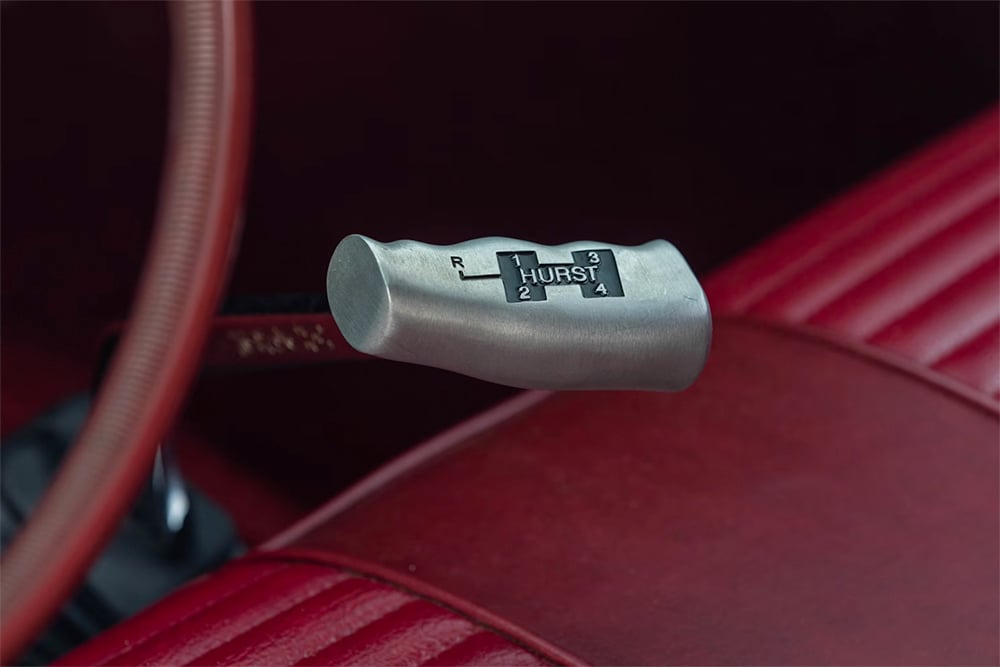
A four-speed Torino Cobra has a special appeal to muscle-car enthusiasts.
There's something wonderfully mechanical about rowing through the gears of a big-block Ford with a stout manual transmission and a healthy V8 soundtrack accompanying every shift.
The transmission code on the data plate helps identify how Ford originally equipped the vehicle.
For example, a 1974 Torino data-plate reference identifies the following transmission codes:
| Code | Transmission |
| 1 | Three-speed manual |
| 5 | Four-speed manual |
| 6 | Four-speed manual |
| W | C4 automatic |
| X | FMX automatic |
| U | C6 automatic |
| Z | Special-duty C6 automatic |
These are 1974 examples, not universal codes for every Torino model year.
A car originally equipped with an automatic transmission may have received a four-speed conversion during its lifetime. Such a modification can make the car more enjoyable to drive, but it doesn't change the factory transmission designation.
For collectors evaluating a high-dollar Cobra Jet, the original transmission specification can have a significant bearing on authenticity and value.
Ford Torino Rear Axle Codes
A muscle car's rear axle is much more than a collection of gears inside a steel housing.
The rear axle ratio affects acceleration, cruising engine speed, and the character of the entire drivetrain.
Ford offered a variety of axle ratios across the Torino lineup, with performance-oriented configurations receiving particular attention during the Cobra Jet years.
For a 1970 Torino equipped with the 429 Cobra Jet, the availability of 3.91 and 4.30 gearing is especially important because those ratios were associated with the Drag Pack and Super Cobra Jet equipment.
But rear axle codes must be decoded by model year. Ford's axle identification systems could distinguish different ratios, conventional and limited-slip configurations, and specialized applications.
If you're investigating a supposedly original Cobra Jet car, compare the door data plate with the axle's physical identification tag and the factory production record.
A replacement third member or complete axle assembly can change the gearing without changing the vehicle's original data plate.
Cobra Jet vs. Super Cobra Jet: What's the Difference?
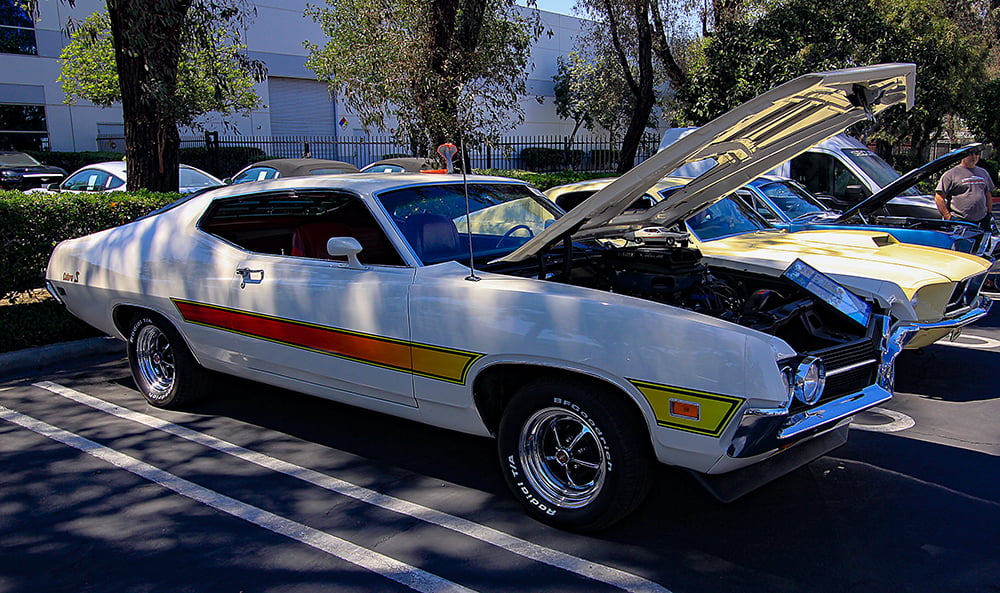
Above: 1970 Torino Cobra 429 (photo by DBS at the Saleen 2025 Open House)
For many Torino enthusiasts, this is where the detective work gets particularly exciting.
The 429 Cobra Jet was a formidable engine in its own right. The Super Cobra Jet designation, however, is associated with additional heavy-duty equipment intended for more demanding performance use.
The distinction wasn't simply a different hood scoop or a set of decals.
In applicable 1970 Torino configurations, the Drag Pack combined steep rear axle gearing with upgraded engine equipment. The package could include heavy-duty internal components and other provisions for sustained high-RPM operation.
Most importantly, the VIN doesn't contain a dedicated Super Cobra Jet identification character.
A J-code 429 identifies a Ram Air Cobra Jet configuration, but it doesn't, by itself, establish that the vehicle received the Drag Pack.
Likewise, a C-code 429 Cobra Jet shouldn't automatically be dismissed as incapable of having factory Drag Pack equipment.
The proper investigation involves the factory production record, original axle designation, engine components, and supporting documentation.
For a valuable collector car, that extra research is time well spent.
How to Verify an Original Torino GT, Cobra, or Gran Torino Sport
Imagine finding a beautiful 1970 Torino advertised as a factory 429 Cobra Jet car.
The paint looks right. The shaker hood looks spectacular. The engine compartment is immaculate. Even the interior appears period correct.
But what does the identification evidence reveal?
The VIN should establish the model year, assembly plant, body series, and original engine designation. The door data plate provides additional clues about the body, paint, trim, transmission, and axle.
For a deeper investigation, one of the most useful resources is a Marti Report.
Marti Auto Works has licensed access to Ford's historical production database and offers vehicle-specific reports for 1967-and-later Ford vehicles. These reports can provide original production and option information that isn't encoded directly into the VIN.
For a serious purchase or concours-level restoration, that information can be invaluable.
A Torino authenticity checklist
Before You Buy or Restore -
- Confirm the dashboard VIN matches the title and available vehicle records
- Decode the VIN using the correct model-year reference
- Compare the door data plate or certification label with the VIN
- Verify original body, paint, trim, transmission, and axle designations
- Identify the installed engine using casting numbers and physical features
- Inspect the rear axle identification tag and transmission markings
- Review any available build sheet, invoice, or Marti Report
- Investigate discrepancies before making originality claims
One more point deserves emphasis: a factory-correct engine designation doesn't prove the original engine block remains in the vehicle.
A Torino can retain its original engine specification while having received a replacement block decades ago.
For serious authenticity claims, the engine's casting dates, engineering numbers, assembly information, and any applicable partial VIN stampings must be considered together.
Restoring a Classic Ford Torino: Originality or Personalization?
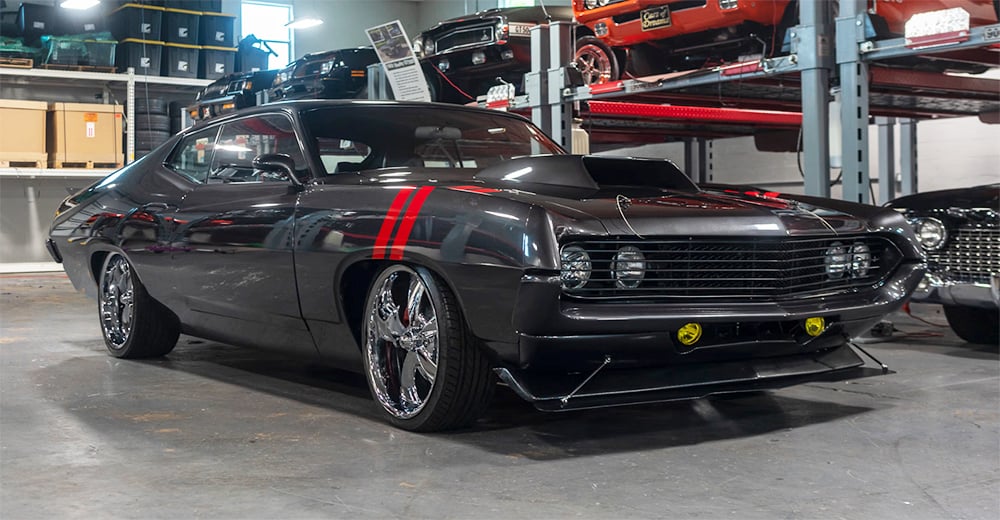
Above: 1970 Ford Torino restomod, sold at Mecum's Orlando Summer Special event in 2021 for $69,300 (photo courtesy of Mecum Auctions)
Not every Torino owner is chasing a concours trophy.
Some enthusiasts want to preserve every original detail, right down to the correct hose clamps, factory-style upholstery, and original paint formulation.
Others prefer a tasteful restomod with improved suspension, modern brakes, electronic ignition, upgraded cooling, and contemporary wheels and tires.
There's room in the hobby for both approaches.
The important thing is to understand what you're starting with.
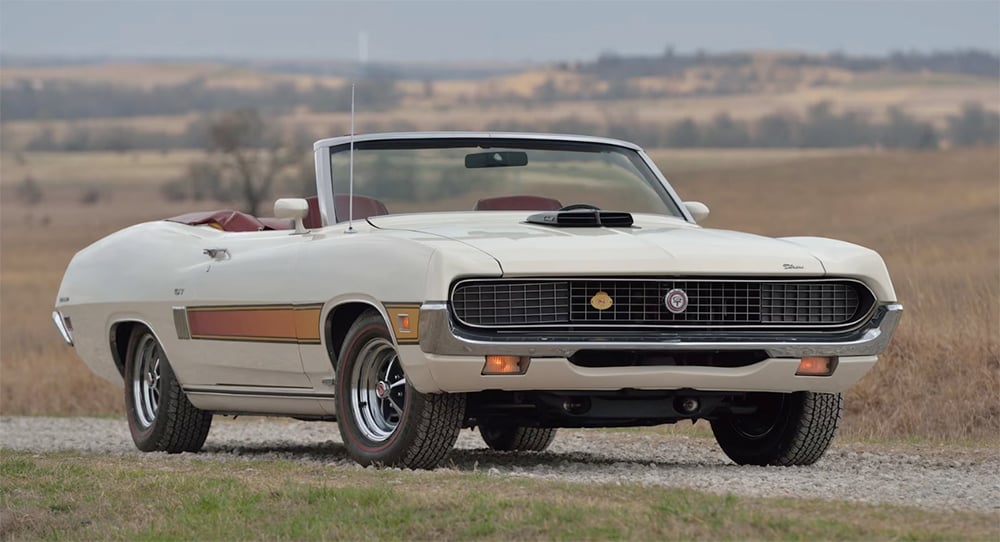
Above: 1970 Cobra Jet Torino GT convertible - one of 37 built CJ convertibles in 1970, sold at Mecum's Indy 2018 event for $74,250 (photo courtesy of Mecum Auctions)
If you own a genuine factory Cobra Jet Torino, preserving its original identification and documenting any modifications is particularly worthwhile.
If you're working with a more common Torino or Gran Torino, you may have greater freedom to create the car you've always wanted.
Either way, identifying the correct model year, body style, and drivetrain helps avoid ordering incorrect replacement parts.
Owners can explore the restoration resources and product offerings at Classic Industries. Always verify application-specific fitment before purchasing components, especially for vehicles with engine or drivetrain swaps.
Frequently Asked Questions About Ford Torino VINs
How many characters are in a 1968–1976 Ford Torino VIN?
Eleven. The VIN identifies the model year, assembly plant, body series, engine designation, and consecutive unit number.
Can a Ford Torino VIN tell me whether my car is a factory Cobra?
The correct model-year body-series code can help establish the factory model designation. Additional documentation may be necessary to verify special equipment and authenticity.
Does a J-code 1970 Torino automatically mean Super Cobra Jet?
No. The J-code identifies the 429 Cobra Jet Ram Air configuration. It does not independently prove Drag Pack or Super Cobra Jet equipment.
Can the VIN tell me my Torino's original paint color?
Not by itself. The factory door data plate or certification label contains the paint designation, which should be decoded using the correct model-year chart.
Can I determine whether my Torino has its original engine?
The VIN identifies the original engine designation, but verifying the installed engine requires additional inspection and documentation.
What is the best way to confirm rare factory options?
A vehicle-specific Marti Report, supported by the original data plate, surviving factory paperwork, and physical inspection, provides a strong basis for verification.
The Last Word: Every Torino Has a Story
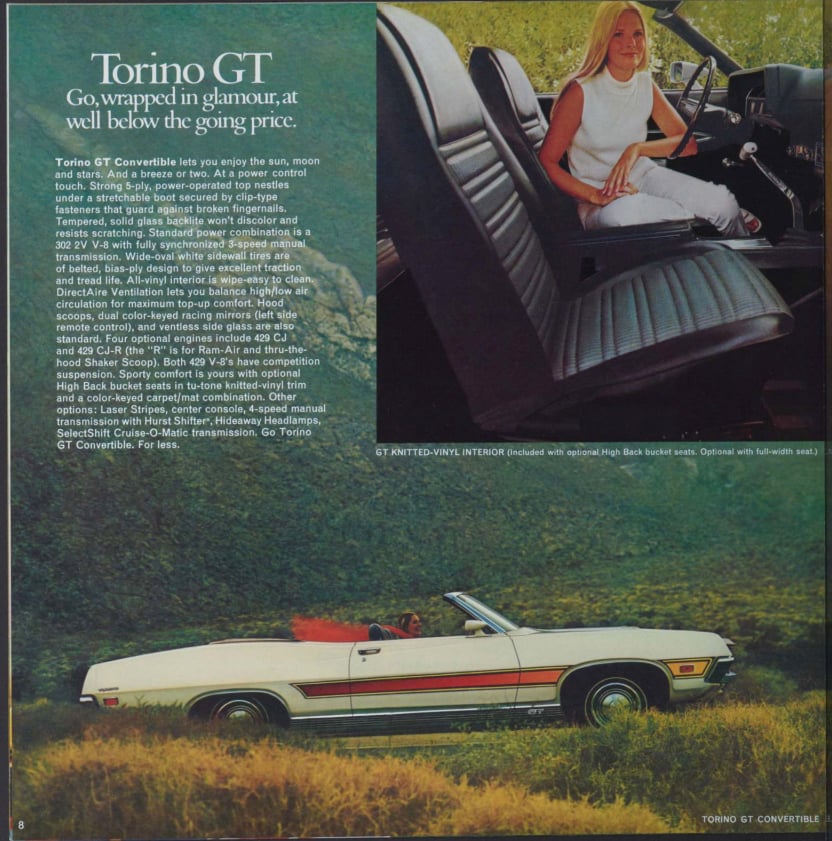
Above: 1970 Ford Torino brochure with a '70 GT convertible at speed (automotive advertising archival artwork courtesy of the Ford Heritage Vault)
From the earliest Fairlane-based Torinos to the big-block Cobras and final-generation Gran Torino coupes, Ford's intermediates occupy a fascinating place in American automotive history.
They weren't merely alternatives to the Mustang. They were distinctive automobiles with their own personalities, engineering achievements, competition heritage, and devoted following.
Some spent their early years making passes down the quarter mile. Others hauled families across the country, served as dependable daily transportation, or spent decades tucked away in garages waiting for a second chance.
Today, those same cars are finding renewed appreciation among collectors, restorers, and enthusiasts who understand that a classic Ford doesn't need a galloping pony on its grille to qualify as an American muscle-car legend.
And sometimes, uncovering a Torino's history begins with something as simple as an 11-character identification number.
So, the next time you encounter a Torino GT, Cobra, or Gran Torino Sport, take a closer look at its VIN and door data plate.
You might discover that the old Blue Oval has quite a story to tell.
Classic Industries - Your Ford Torino and Fairlane Parts Source
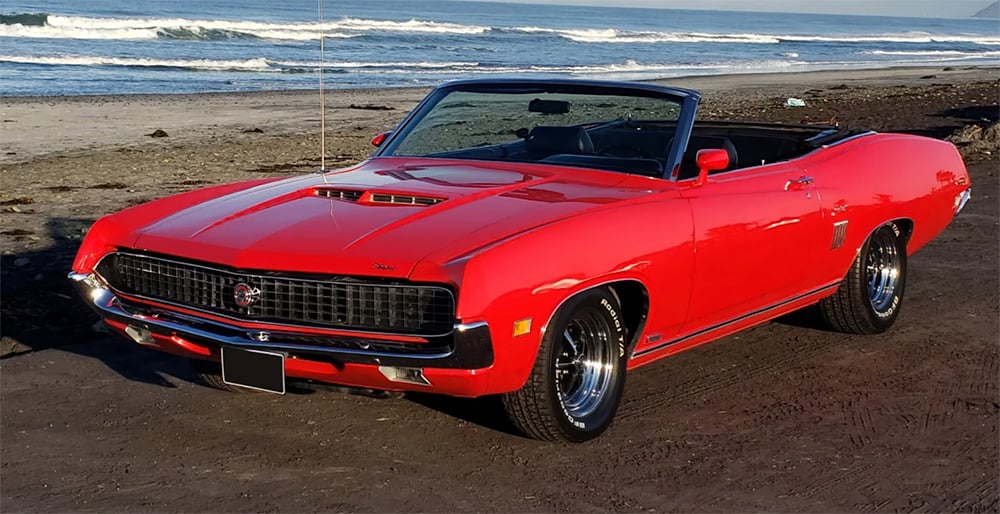
Above: 1970 Torino convertible (photo courtesy of Mecum Auctions)
Basically, a Torino could be equipped for daily driving duties, running passes at the dragstrip, or winning NASCAR races, not to mention going vintage racing today.
More Ford History Articles
If you're interested in learning more about the history of classic Ford vehicles, check out some of our previous articles below:
- 1955-70 Ford Fairlane History
- 1959-74 Ford Galaxie History
- 1960-70.5 Ford Falcon History
- 1968-76 Ford Torino History
- Ford Mustang History
Above and below: 1970 Ford Torino Cobra Twister Special - VIN: 0A38J131604, sold at Kissimmee, Florida 2025 Mecum Auctions event for $159,500 (photos courtesy of Mecum Auctions)
Above and below: 1972 Gran Torino - sold at Mecum Auctions Houston, Texas - VIN: 2A38H253127, 2021 event for $30,800 (photos courtesy of Mecum Auctions)
A substantial redesign brought a new body and chassis architecture. The Gran Torino Sport preserved a measure of Ford's muscle-car spirit, although emissions requirements, insurance costs, and changing market conditions were transforming the American performance landscape.
Above and below: For the filming of the popular Starsky & Hutch television show in the mid-1970's, 1974, 1975, and 1976 Gran Torinos were used. These photos show a 1974 Gran Torino Starsky & Hutch promotional vehicle, built by the famous George Barris, that sold at the Harrisburg, Pennsylvania Mecum Auctions event for $27,500 (photos courtesy of Mecum Auctions)
By the mid-1970s, the Torino had evolved into a larger personal and family automobile. V8 engines remained available, but comfort, styling, and everyday drivability took precedence over quarter-mile heroics. The Torino nameplate concluded after the 1976 model year.
Where to Find the VIN on a 1968–1976 Ford Torino
Before we begin translating numbers and letters, we need to locate the vehicle's identification information.
Above: VIN at base of dash panel underneath the windshield, door tag, and vehicle certification label
For these model years, the primary VIN can be found on the instrument panel, visible through the windshield. Ford also provided identification information on the driver's door area, with the precise format and attachment method varying by year.
The key places to inspect are the dashboard VIN plate and the driver's door data plate or certification label. On a car undergoing major restoration, additional body identification stampings may also be useful, although their location and accessibility vary.
Compare the visible VIN with the vehicle's title and registration. If the car has been repainted or restored, examine the identification plates for evidence of alteration, replacement, or damage.
A replaced driver's door doesn't necessarily indicate wrongdoing. After all, these cars are approaching 50 to 60 years of age. Nevertheless, discrepancies deserve investigation before purchasing a supposedly rare factory muscle car.
Understanding Ford's 11-Character VIN
Ford passenger cars of this era used an 11-character vehicle identification number.
A useful example is a documented 1971 Torino GT convertible carrying VIN 1H37H139090. Its Deluxe Marti Report identifies the car as a Lorain-built Torino GT convertible with a 351-cubic-inch two-barrel V8.
DOCUMENTED 1971 TORINO GT VIN
1
Year
H
Plant
37
Series
H
Engine
139090
Sequence
Complete VIN: 1H37H139090
| VIN position | Identification |
| First character | Model year |
| Second character | Assembly plant |
| Third and fourth | Body series/model |
| Fifth character | Factory engine designation |
| Last six characters | Consecutive unit number |
The VIN is our starting point, not the end of the investigation. Ford's period identification literature confirms this general layout for 1970–1972 passenger cars.
Model-year identification codes
| Model year | First VIN character |
| 1968 | 8 |
| 1969 | 9 |
| 1970 | 0 |
| 1971 | 1 |
| 1972 | 2 |
| 1973 | 3 |
| 1974 | 4 |
| 1975 | 5 |
| 1976 | 6 |
Here's a detail worth remembering: the VIN identifies the model year, not necessarily the calendar year in which the car was assembled. A 1971 Torino might have been built during the latter part of 1970.
That distinction becomes important when researching production changes and identifying original equipment.
Ford Torino Assembly Plant Codes
Above: The Ford assembly plant, located just south of Atlanta near the Hartsfield-Jackson International Airport, makes the Taurus and used to produce the mighty Torino, which is being phased out (image from 2008 - Barry Williams / Getty Images file).
The second VIN character identifies the Ford assembly plant assigned to manufacture the vehicle.
The following are important assembly-plant codes encountered in Ford passenger-car identification references from this era. Not every plant built Torinos in every model year.
| Code | Assembly plant |
| A | Atlanta, Georgia |
| F | Dearborn, Michigan |
| G | Chicago, Illinois |
| H | Lorain, Ohio |
| K | Kansas City, Missouri |
| N | Norfolk, Virginia |
| R | San Jose, California |
| T | Metuchen, New Jersey |
| U | Louisville, Kentucky |
The plant code should be checked against the specific model year and body series. A code that appears in a general Ford reference doesn't automatically mean that plant produced every Torino variation.
Decoding Ford Torino Body Series and Model Codes
The third and fourth characters of the VIN are especially interesting because they help establish which model Ford intended to build.
These are not the same as the three-character BODY codes on the door data plate.
For example, a documented 1971 Torino GT convertible has 37 in its VIN, while its door data plate identifies the body configuration as 76F.
That's why we need both identifiers.
The 1968–1969 Fairlane and Torino years
Above: The first two pages of the 1968 Ford Fairlane brochure, where the Torino is introduced - The Ford Heritage Vault is a great resource for learning more about the glorious Ford, Lincoln, and Mercury models from Ford's illustrious past (photo courtesy of the Ford Heritage Vault).
Above: A 1969 Torino Talladega, one of 750 produced, VIN: 9A46Q201887, sold at Mecum Auctions Kissimmee, Florida 2024 event for $73,700 (photo courtesy of Mecum Auctions).
During these early years, the Fairlane and Torino shared much of their engineering and model identification structure.
The 1968 lineup included Fairlane, Fairlane 500, Torino, Torino GT, and Torino Squire models. Among the more interesting VIN body-series codes were:
| 1968 VIN series code | Model |
| 30 | Fairlane two-door hardtop |
| 31 | Fairlane four-door sedan |
| 32 | Fairlane station wagon |
| 34 | Fairlane 500 four-door sedan |
| 37 | Fairlane 500 station wagon |
| 38 | Torino Squire station wagon |
| 40 | Torino two-door hardtop |
| 41 | Torino four-door sedan |
| 42 | Torino GT fastback |
| 43 | Torino GT convertible |
| 44 | Torino GT formal-roof hardtop |
These entries are drawn from a 1968 Ford identification reference; the complete body-series tables should be treated as model-year-specific, particularly for 1969 and later.
| VIN series code | Ford model | Factory body style |
|---|---|---|
| 30 | Fairlane | Two-door formal-roof hardtop |
| 31 | Fairlane | Four-door sedan |
| 32 | Fairlane | Four-door station wagon |
| 33 | Fairlane 500 | Two-door formal-roof hardtop |
| 34 | Fairlane 500 | Four-door sedan |
| 35 | Fairlane 500 | Two-door SportsRoof fastback |
| 36 | Fairlane 500 | Convertible |
| 37 | Fairlane 500 | Four-door station wagon |
| 38 | Torino Squire | Four-door station wagon |
| 40 | Torino | Two-door formal-roof hardtop |
| 41 | Torino | Four-door sedan |
| 42 | Torino GT | Two-door SportsRoof fastback |
| 43 | Torino GT | Convertible |
| 44 | Torino GT | Two-door formal-roof hardtop |
| 45 | Cobra | Two-door formal-roof hardtop |
| 46 | Cobra | Two-door SportsRoof fastback |
Source: Ford Motor Company's 1969 Car Shop Manual, Volume One, Vehicle Identification, section 01-01-04.carmanualsonline.info
Note: The legendary 1969 Ford Torino Talladega also carried the 46 body-series designation. However, the 46 code alone doesn't establish that a vehicle is an authentic Talladega. Production Talladegas used the Atlanta assembly-plant code A and the 428 Cobra Jet Q-code engine designation, with additional documentation needed to establish authenticity. Talladegas and Spoilers Registry
The Torino GT fastback is especially significant. Its sloping roofline wasn't simply a styling exercise. Ford was deeply involved in NASCAR competition, and aerodynamic efficiency was becoming a major consideration in stock-car racing.
The Torino Talladega, introduced for 1969, pushed that philosophy even further with a modified front end designed to improve high-speed aerodynamics.
These two-digit VIN body-series codes with the three-character BODY codes on Ford's door data plate. For example, a 1969 Torino GT SportsRoof has VIN series 42, but its door BODY code depends on its factory seating configuration.
The 1970–1971 Torino and Cobra years
Above and below: This 1970 Torino GT with some sweet restomod touches, VIN: 0A35M237932, sold at Mecum Auctions Indy Fall Special 2025 for $60,500 (photos courtesy of Mecum Auctions).
The 1970 redesign brought one of the most aggressive-looking intermediates of the muscle-car era.
With its pronounced body contours, wide stance, and available high-performance engines, the Torino Cobra was a serious contender in the muscle-car wars.
Above and below: This 1970 Torino Cobra with a 429 Cobra Jet V8 that's backed by a factory four-speed manual and is equipped with the Factory Drag Pack, sold at the Mecum 2021 Glendale, Arizona event for $68,200, VIN: 0A38J163515. Enjoy the stunning even light or magic light photography here and by clicking the link just above (awesome photos courtesy of Mecum Auctions).
By 1971, Ford had further reorganized its intermediate lineup, with the Fairlane name disappearing from the passenger-car range.
Above: 1971 Torino convertible, VIN: 1H37M194474, sold at Mecum Auctions Kissimmee, Florida 2018 event for $42,900 (photo courtesy of Mecum Auctions)
The critical lesson for decoding these cars is that a Cobra, Torino GT, and ordinary Torino must be distinguished using the correct year's body-series information, rather than by relying on stripes, badges, hood scoops, or an engine swap.
A beautiful restoration can recreate the appearance of a rare performance model. Only the correct identification evidence can establish how Ford originally built it.
The 1972–1976 Gran Torino years
Above: 1972 Gran Torino, VIN: 2A35H224785, sold at the Mecum Auctions Kissimmee, Florida Summer Special 2023 event for $37,400 (photo courtesy of Mecum Auctions)
Beginning in 1972, Ford introduced a substantially redesigned Torino with new styling, a different chassis, and an expanded Gran Torino identity.
The door data plate provides especially useful body-style information for these cars.
The following examples illustrate several factory BODY codes for 1973 and 1974:
| Door BODY code | Model/body style |
| 53B | Torino four-door sedan |
| 65B | Torino two-door hardtop |
| 71B | Torino four-door station wagon |
| 53D | Gran Torino four-door sedan |
| 65D | Gran Torino two-door hardtop |
| 71D | Gran Torino four-door station wagon |
| 71K | Gran Torino Squire wagon |
| 63R | Gran Torino Sport fastback (1973) |
| 65R | Gran Torino Sport hardtop |
| 53K | Gran Torino Brougham four-door sedan |
| 65K | Gran Torino Brougham two-door hardtop |
| 65M | Gran Torino Elite two-door hardtop (1974) |
Above: 1973 Gran Torino with a 351 cubic inch V8 backed by a four-speed manual (rare), VIN: 3H35Q172370, sold at Mecum Auctions Indy 2019 event for $25,300 (photo courtesy of Mecum Auctions)
The 1973 data-plate reference lists both 63R and 65R Gran Torino Sport bodies. The 1974 reference lists 65R but not 63R, reflecting the disappearance of the SportsRoof fastback configuration.
Above: Here's the last page of the 1974 Ford Torino brochure showing the various '74 Torino models, as well as exterior hues, interior colors and trim selections, and options. Get yourself to the Ford Heritage Vault, if you're also a fan of automobilia (photo courtesy of the Ford Heritage Vault).
One important wrinkle: the Torino Elite became a separate Ford Elite nameplate for 1975. It shouldn't automatically be counted as a Torino for the final two years.
Ford Torino Engine Codes: Where the Horsepower Story Begins
The fifth character of the VIN identifies the engine originally designated for the vehicle.
For muscle-car enthusiasts, this is often the first character they look for after confirming the model year.
A factory big-block Cobra Jet is considerably more interesting to many collectors than a Torino originally equipped with a small-block V8, even when the two cars now look virtually identical.
However, Ford's engine-code assignments changed over time. A code from 1969 should never be assumed to carry the same meaning in 1975.
1968–1969: The FE big-block years
Above: 1969 428SCJ Ford big-block V8 mill (code R) in the '69 black over read 1969 Torino fastback above (photo courtesy of Mecum Auctions)
Among the most desirable engines of this period were Ford's FE-series 390 and 428 V8s.
1968 Ford Fairlane and Torino Engine Codes
| VIN engine code | Engine identification | Factory-rated horsepower |
|---|---|---|
| T | 200-cu.-in. inline-six, one-barrel | 115 HP |
| C | 289-cu.-in. V8, two-barrel (early production) | 195 HP |
| F | 302-cu.-in. V8, two-barrel | 210 HP |
| J | 302-cu.-in. V8, four-barrel | 230 HP |
| Y | 390-cu.-in. V8, two-barrel | 265 HP |
| S | 390-cu.-in. V8, four-barrel GT | 325 HP |
| Q | 428-cu.-in. V8, four-barrel, non-Ram Air application | 335 HP |
| R | 428 Cobra Jet V8, four-barrel, Ram Air | 335 HP |
Note: Horsepower figures are period SAE gross ratings. Engine availability varied by model and production date.
1968 notes: The 289 two-barrel was an early-production engine before the 302 became the principal small-block offering. Ford introduced the 428 Cobra Jet during the 1968 model year, making its availability dependent on production timing. The Q- and R-code 428 entries should be checked against the specific Fairlane/Torino application and build date rather than assumed to have been offered throughout the year.
Above and below: Original Ford 302 small block V8 two-barrel carb (code F) in a 1969 Torino (photos courtesy of Mecum Auctions)
1969 Ford Fairlane and Torino Engine Codes
| VIN engine code | Engine identification | Factory-rated horsepower |
|---|---|---|
| L | 250-cu.-in. inline-six, one-barrel | 155 HP |
| F | 302-cu.-in. V8, two-barrel | 220 HP |
| H | 351 Windsor V8, two-barrel | 250 HP* |
| M | 351 Windsor V8, four-barrel | 290 HP |
| S | 390-cu.-in. V8, four-barrel | 320 HP |
| Q | 428 Cobra Jet V8, four-barrel, without Ram Air | 335 HP |
| R | 428 Cobra Jet V8, four-barrel, with Ram Air | 335 HP |
*Some Ford period brochures list the 351 two-barrel at 240 HP, while other references list 250 HP. The factory brochure for the specific production period should govern the published rating.
These codes illustrate important Ford engine designations of the period; availability differed by year, body style, and vehicle line. In particular, the Q-code 428 should not be interpreted as a universal Cobra Jet designation without checking the exact model-year application.
The 428 Cobra Jet deserves special attention. Introduced during 1968, it quickly established itself as one of Ford's most formidable street-performance engines.
With its substantial displacement, strong torque output, and competition-inspired engineering, the Cobra Jet transformed well-styled Ford intermediates into serious street machines.
And unlike a hood decal, a correct factory engine code is part of the vehicle's original identification record.
What changed between 1968 and 1969?
The big news for 1969 was Ford's introduction of the 351 Windsor V8, available with either a two-barrel or four-barrel carburetor. The 250-cubic-inch inline-six replaced the smaller 200 as the base six-cylinder engine.
The 1968 289 two-barrel and 302 four-barrel disappeared from the regular 1969 intermediate lineup. Ford also discontinued the 390 two-barrel, retaining the 390 four-barrel as an optional big-block V8.
Meanwhile, the mighty 428 Cobra Jet continued into 1969, most notably as standard equipment in the new Ford Cobra. The 428 remained available in both non-Ram Air and Ram Air configurations, identified by the Q and R VIN engine codes, respectively. Over-Drive-Magazine
1970–1971: The 429 Cobra Jet takes center stage
Above: 1970 Torino 429SCJ mill - 429 big-block Ford V8 Super Cobra Jet engine (code J) (photo courtesy of Mecum Auctions)
For 1970, Ford's 385-series 429 V8 became the headline big-block performance engine in the Torino.
| VIN engine code | Engine designation |
| N | 429 standard four-barrel, without Ram Air |
| C | 429 Cobra Jet four-barrel, without Ram Air |
| J | 429 Cobra Jet four-barrel, with Ram Air |
These distinctions are especially important when authenticating a 1970 or 1971 Torino.
The J-code is understandably coveted. After all, few sights are more appealing to a Ford enthusiast than a factory-style shaker assembly rising through the hood of a Torino Cobra.
But here's an essential distinction:
A J-code Torino is not automatically a Super Cobra Jet.
The Super Cobra Jet designation involved additional heavy-duty performance equipment associated with the Drag Pack. That package isn't identified by a separate SCJ character in the VIN.
A C-code Torino could also receive Drag Pack equipment in applicable configurations. For a 1970 car, a factory 3.91 or 4.30 axle designation can be a valuable clue, but factory documentation remains the stronger evidence.
For 1971, production records and period literature require particular care when investigating claims of factory-installed Drag Pack equipment. An engine code alone is insufficient. Research citing Marti Auto Works indicates that although the Drag Pack appeared in 1971 literature and preproduction testing, production records show it was installed only on Mustangs that model year, not production Torinos.
1972–1973: The 351 Cobra Jet and the changing performance landscape
Ford's 1972 Torino redesign coincided with a dramatic shift in the American automotive industry.
Emissions regulations, changing fuel requirements, and insurance costs were reshaping the high-performance market. The industry also transitioned from SAE gross horsepower ratings to SAE net ratings, making direct comparisons between 1971 and 1972 horsepower figures misleading.
Video: The Boss 351 Cleveland Cobra Mill was Special!
The 351 Cleveland four-barrel Cobra Jet became one of the most interesting performance engines in the new Gran Torino.
| Engine code | 1972–1973 engine identification |
| L | 250-cu.-in. inline-six |
| F | 302-cu.-in. two-barrel V8 |
| H | 351-cu.-in. two-barrel V8 |
| Q | 351 Cleveland four-barrel Cobra Jet V8 |
| S | 400-cu.-in. two-barrel V8 |
| N | 429-cu.-in. four-barrel V8 |
| A | 460-cu.-in. four-barrel V8, 1973 police application |
The Q-code 351 Cobra Jet is an especially desirable identification for enthusiasts seeking a factory performance-oriented 1972 or 1973 Torino. The H-code requires further investigation because Ford offered different 351 engine families under the same broad VIN designation.
A 351 Windsor and a 351 Cleveland are not interchangeable from a restoration-parts standpoint. Their cylinder heads, intake manifolds, cooling arrangements, and numerous other components differ.
Consequently, a VIN that identifies a 351 two-barrel V8 doesn't always establish which engine family is physically installed today.
1974–1976: The final Torino engines
Above: With the cover artwork for the 1975 Ford Torino brochure, one can readily see that the American muscle car days of yore had receded way back into horizon of the rear-view mirror of the early 1970's and the swingin' horsepower wars of the 1960's. That's not a two-door fastback Torino GT coupe on the cover. It's a four-door sedan with a young Yuppie couple looking towards a bright future in the suburbs. Indeed, it almost looks like the 'Six-Million-Dollar Man' (actor Lee Majors) and the 'Six-Million-Dollar Woman' (actress Lyndsey Wagner) poised ready for executive action when they're not fighting crime (photo courtesy of Ford Heritage Vault).
By the mid-1970s, the Torino was primarily a comfortable, substantial American automobile rather than an all-out street-performance machine.
Nevertheless, Ford continued offering a variety of V8 powerplants, including the 351, 400, and 460.
Among the important later engine codes were:
| Code | Engine | Model-year context |
| H | 351 two-barrel V8 | 1975–1976 |
| S | 400 two-barrel V8 | 1975–1976 |
| A | 460 four-barrel V8 | 1975–1976 |
| C | 460 four-barrel Police Interceptor V8 | 1975–1976 police applications |
The H-code can encompass both the 351 Windsor and 351 Modified families, depending on application.
For restorers, that distinction is particularly important. Before ordering major engine components, confirm the actual engine family using casting numbers, external identification features, and appropriate Ford service literature.
A VIN decoder is an excellent starting point. It isn't a substitute for physically identifying the engine.
Decoding the Ford Torino Door Data Plate
If the VIN is the Torino's birth certificate, think of the factory door data plate as a more detailed description of the automobile Ford intended to build.
Depending on the model year, the plate or certification label contains fields identifying the vehicle's body configuration, exterior paint, interior trim, scheduled production information, sales district, transmission, and rear axle.
The familiar Ford identification fields include:
| Data plate field | What it identifies |
| VIN / VEH IDENT NO. | Vehicle identification number |
| BODY | Factory body configuration |
| COLOR / COL | Original exterior paint |
| TRIM | Factory interior trim |
| DATE | Scheduled build date on applicable early plates |
| DSO | District Sales Office or special-order designation |
| AXLE | Original rear axle designation |
| TRANS / TRNS | Factory transmission designation |
The precise format changes across the years. Some later certification labels show a month/year of manufacture separately from the other identification fields.
Understanding the DATE code
On early Ford data plates, a code such as 15M represents a scheduled build date of December 15.
Ford used letters to represent months, with I omitted:
| Code | Month | Code | Month |
| A | January | G | July |
| B | February | H | August |
| C | March | J | September |
| D | April | K | October |
| E | May | L | November |
| F | June | M | December |
The scheduled date should not be confused with the actual day the car rolled down the assembly line.
According to Marti Auto Works, Ford's production records can distinguish the scheduled build date, actual build date, release date, and original sale date. Those dates aren't necessarily identical.
For a meticulous restoration, knowing the actual production timing can be especially useful when investigating midyear engineering changes.
Ford Torino Exterior Paint Codes
Original paint colors are among the most fascinating aspects of classic Ford identification.
A Torino Cobra wearing a period-correct shade of Grabber Blue or Calypso Coral can be a stunning sight. But a beautifully applied modern repaint doesn't prove that the vehicle originally left the factory wearing that color.
The COLOR field on the door data plate identifies the original factory paint designation.
For example, below are some 1973 Ford Torino paint codes that appear in model-year-specific identification references. The table below is not the complete list of paint codes for the 1973 model year. It's just providing eight examples.
| 1973 paint code | Factory color |
| 2B | Bright Red |
| 3B | Light Blue |
| 3D | Medium Blue Metallic |
| 3K | Blue Glow |
| 4C | Ivy Glow |
| 4Q | Dark Green Metallic |
| 5A | Light Pewter Metallic |
| 5M | Medium Copper Metallic |
Here's something every restorer should appreciate: Ford paint codes weren't necessarily consistent from one model year to another.
Marti Auto Works explains that Ford sometimes assigned different names and identification codes to essentially the same paint formula over several years. One particular blue, for example, appeared under multiple names and codes between 1967 and 1972.
That's why matching a paint code to the correct model year is critical.
For restoration accuracy, the factory paint number or original paint formulation is often more valuable than the color name alone.
Decoding the Interior TRIM Code
A Torino's original interior can be every bit as distinctive as its exterior.
Bucket seats, bench seats, vinyl upholstery, cloth inserts, door panels, carpeting, and dashboard appointments all contributed to the personality of these cars.
The TRIM code helps identify the original interior configuration, including the upholstery material and color.
However, trim codes changed by model year and body series. A two-character code found on a 1969 Torino GT shouldn't automatically be decoded using a 1974 Gran Torino chart.
For an accurate restoration, compare the trim code against the appropriate Ford model-year identification manual and, where available, original production records.
This is particularly important when restoring a car that has undergone multiple interior changes over the decades.
A Torino may have started life with a bench seat and later received bucket seats, a floor shifter, and a center console. The modifications might look terrific, but they don't necessarily represent its original factory configuration.
What Does DSO Mean on a Ford Torino?
The DSO designation is another interesting piece of Ford's identification puzzle.
DSO generally refers to the District Sales Office, identifying the sales district through which a vehicle was ordered.
A few examples of Ford district codes used during the Torino era include:
| DSO code | Sales district |
| 11 | Boston |
| 21 | Atlanta |
| 41 | Chicago |
| 48 | Detroit |
| 52 | Dallas |
| 53 | Kansas City |
| 71 | Los Angeles |
| 72 | San Jose |
| 74 | Seattle |
| 76 | Denver |
These examples appear in period-specific Torino data-plate references.
The DSO can help tell the story of a particular car's original ordering history.
Imagine discovering that your California-owned Torino Cobra was originally ordered through Ford's Detroit sales district. That little detail might prompt an interesting investigation into its early ownership and travels.
A two-digit DSO generally identifies a district. Certain special-order vehicles can carry longer DSO designations, which require additional documentation to interpret correctly.
It's also important to understand that the ordering district doesn't necessarily identify the exact dealership that originally sold the car.
For that information, a factory invoice, original sales paperwork, or Marti Report may be necessary.
Ford Torino Transmission Codes
A four-speed Torino Cobra has a special appeal to muscle-car enthusiasts.
There's something wonderfully mechanical about rowing through the gears of a big-block Ford with a stout manual transmission and a healthy V8 soundtrack accompanying every shift.
The transmission code on the data plate helps identify how Ford originally equipped the vehicle.
For example, a 1974 Torino data-plate reference identifies the following transmission codes:
| Code | Transmission |
| 1 | Three-speed manual |
| 5 | Four-speed manual |
| 6 | Four-speed manual |
| W | C4 automatic |
| X | FMX automatic |
| U | C6 automatic |
| Z | Special-duty C6 automatic |
These are 1974 examples, not universal codes for every Torino model year.
A car originally equipped with an automatic transmission may have received a four-speed conversion during its lifetime. Such a modification can make the car more enjoyable to drive, but it doesn't change the factory transmission designation.
For collectors evaluating a high-dollar Cobra Jet, the original transmission specification can have a significant bearing on authenticity and value.
Ford Torino Rear Axle Codes
A muscle car's rear axle is much more than a collection of gears inside a steel housing.
The rear axle ratio affects acceleration, cruising engine speed, and the character of the entire drivetrain.
Ford offered a variety of axle ratios across the Torino lineup, with performance-oriented configurations receiving particular attention during the Cobra Jet years.
For a 1970 Torino equipped with the 429 Cobra Jet, the availability of 3.91 and 4.30 gearing is especially important because those ratios were associated with the Drag Pack and Super Cobra Jet equipment.
But rear axle codes must be decoded by model year. Ford's axle identification systems could distinguish different ratios, conventional and limited-slip configurations, and specialized applications.
If you're investigating a supposedly original Cobra Jet car, compare the door data plate with the axle's physical identification tag and the factory production record.
A replacement third member or complete axle assembly can change the gearing without changing the vehicle's original data plate.
Cobra Jet vs. Super Cobra Jet: What's the Difference?
Above: 1970 Torino Cobra 429 (photo by DBS at the Saleen 2025 Open House)
For many Torino enthusiasts, this is where the detective work gets particularly exciting.
The 429 Cobra Jet was a formidable engine in its own right. The Super Cobra Jet designation, however, is associated with additional heavy-duty equipment intended for more demanding performance use.
The distinction wasn't simply a different hood scoop or a set of decals.
In applicable 1970 Torino configurations, the Drag Pack combined steep rear axle gearing with upgraded engine equipment. The package could include heavy-duty internal components and other provisions for sustained high-RPM operation.
Most importantly, the VIN doesn't contain a dedicated Super Cobra Jet identification character.
A J-code 429 identifies a Ram Air Cobra Jet configuration, but it doesn't, by itself, establish that the vehicle received the Drag Pack.
Likewise, a C-code 429 Cobra Jet shouldn't automatically be dismissed as incapable of having factory Drag Pack equipment.
The proper investigation involves the factory production record, original axle designation, engine components, and supporting documentation.
For a valuable collector car, that extra research is time well spent.
How to Verify an Original Torino GT, Cobra, or Gran Torino Sport
Imagine finding a beautiful 1970 Torino advertised as a factory 429 Cobra Jet car.
The paint looks right. The shaker hood looks spectacular. The engine compartment is immaculate. Even the interior appears period correct.
But what does the identification evidence reveal?
The VIN should establish the model year, assembly plant, body series, and original engine designation. The door data plate provides additional clues about the body, paint, trim, transmission, and axle.
For a deeper investigation, one of the most useful resources is a Marti Report.
Marti Auto Works has licensed access to Ford's historical production database and offers vehicle-specific reports for 1967-and-later Ford vehicles. These reports can provide original production and option information that isn't encoded directly into the VIN.
For a serious purchase or concours-level restoration, that information can be invaluable.
A Torino authenticity checklist
Before You Buy or Restore -
- Confirm the dashboard VIN matches the title and available vehicle records
- Decode the VIN using the correct model-year reference
- Compare the door data plate or certification label with the VIN
- Verify original body, paint, trim, transmission, and axle designations
- Identify the installed engine using casting numbers and physical features
- Inspect the rear axle identification tag and transmission markings
- Review any available build sheet, invoice, or Marti Report
- Investigate discrepancies before making originality claims
One more point deserves emphasis: a factory-correct engine designation doesn't prove the original engine block remains in the vehicle.
A Torino can retain its original engine specification while having received a replacement block decades ago.
For serious authenticity claims, the engine's casting dates, engineering numbers, assembly information, and any applicable partial VIN stampings must be considered together.
Restoring a Classic Ford Torino: Originality or Personalization?
Above: 1970 Ford Torino restomod, sold at Mecum's Orlando Summer Special event in 2021 for $69,300 (photo courtesy of Mecum Auctions)
Not every Torino owner is chasing a concours trophy.
Some enthusiasts want to preserve every original detail, right down to the correct hose clamps, factory-style upholstery, and original paint formulation.
Others prefer a tasteful restomod with improved suspension, modern brakes, electronic ignition, upgraded cooling, and contemporary wheels and tires.
There's room in the hobby for both approaches.
The important thing is to understand what you're starting with.
Above: 1970 Cobra Jet Torino GT convertible - one of 37 built CJ convertibles in 1970, sold at Mecum's Indy 2018 event for $74,250 (photo courtesy of Mecum Auctions)
If you own a genuine factory Cobra Jet Torino, preserving its original identification and documenting any modifications is particularly worthwhile.
If you're working with a more common Torino or Gran Torino, you may have greater freedom to create the car you've always wanted.
Either way, identifying the correct model year, body style, and drivetrain helps avoid ordering incorrect replacement parts.
Owners can explore the restoration resources and product offerings at Classic Industries. Always verify application-specific fitment before purchasing components, especially for vehicles with engine or drivetrain swaps.
Frequently Asked Questions About Ford Torino VINs
How many characters are in a 1968–1976 Ford Torino VIN?
Eleven. The VIN identifies the model year, assembly plant, body series, engine designation, and consecutive unit number.
Can a Ford Torino VIN tell me whether my car is a factory Cobra?
The correct model-year body-series code can help establish the factory model designation. Additional documentation may be necessary to verify special equipment and authenticity.
Does a J-code 1970 Torino automatically mean Super Cobra Jet?
No. The J-code identifies the 429 Cobra Jet Ram Air configuration. It does not independently prove Drag Pack or Super Cobra Jet equipment.
Can the VIN tell me my Torino's original paint color?
Not by itself. The factory door data plate or certification label contains the paint designation, which should be decoded using the correct model-year chart.
Can I determine whether my Torino has its original engine?
The VIN identifies the original engine designation, but verifying the installed engine requires additional inspection and documentation.
What is the best way to confirm rare factory options?
A vehicle-specific Marti Report, supported by the original data plate, surviving factory paperwork, and physical inspection, provides a strong basis for verification.
The Last Word: Every Torino Has a Story
Above: 1970 Ford Torino brochure with a '70 GT convertible at speed (automotive advertising archival artwork courtesy of the Ford Heritage Vault)
From the earliest Fairlane-based Torinos to the big-block Cobras and final-generation Gran Torino coupes, Ford's intermediates occupy a fascinating place in American automotive history.
They weren't merely alternatives to the Mustang. They were distinctive automobiles with their own personalities, engineering achievements, competition heritage, and devoted following.
Some spent their early years making passes down the quarter mile. Others hauled families across the country, served as dependable daily transportation, or spent decades tucked away in garages waiting for a second chance.
Today, those same cars are finding renewed appreciation among collectors, restorers, and enthusiasts who understand that a classic Ford doesn't need a galloping pony on its grille to qualify as an American muscle-car legend.
And sometimes, uncovering a Torino's history begins with something as simple as an 11-character identification number.
So, the next time you encounter a Torino GT, Cobra, or Gran Torino Sport, take a closer look at its VIN and door data plate.
You might discover that the old Blue Oval has quite a story to tell.
Classic Industries - Your Ford Torino and Fairlane Parts Source
Above: 1970 Torino convertible (photo courtesy of Mecum Auctions)
Basically, a Torino could be equipped for daily driving duties, running passes at the dragstrip, or winning NASCAR races, not to mention going vintage racing today.
More Ford History Articles
If you're interested in learning more about the history of classic Ford vehicles, check out some of our previous articles below: